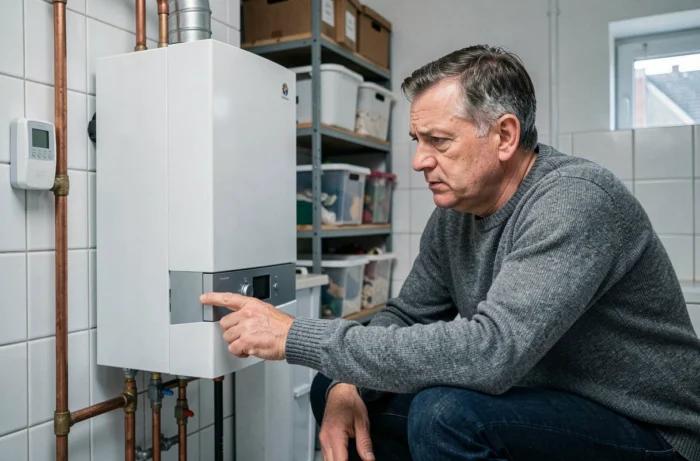
Your gas boiler is still working very well, but you hear talk of bans, rising excise taxes, and heat pumps everywhere. Should you be worried about your gas heating in Brussels in 2025? The answer mainly depends on the type of housing you occupy and your medium-term plans.
Atmospheric boiler in Brussels: the first device in the crosshairs
Even before discussing a ban on gas, a concrete change is already affecting many Brussels buildings. As of January 1, 2025, owners of an atmospheric boiler or water heater (type B11BS) connected to a collective chimney must conduct a feasibility analysis to consider its replacement.
This type of device, very common in apartments built before the 2000s, expels burned gases through a shared duct. Its efficiency is low, and there are risks of CO poisoning. The obligation does not yet force immediate replacement, but it requires documentation of equipment connected to the chimney since 2019.
Specifically, if you live in a building with this system, your property manager or you must order this analysis. The goal is to prepare the transition to flue gas appliances or other solutions. The relevance of gas heating is evaluated on a case-by-case basis, taking into account the building’s configuration.
Gas ban in new constructions in Brussels
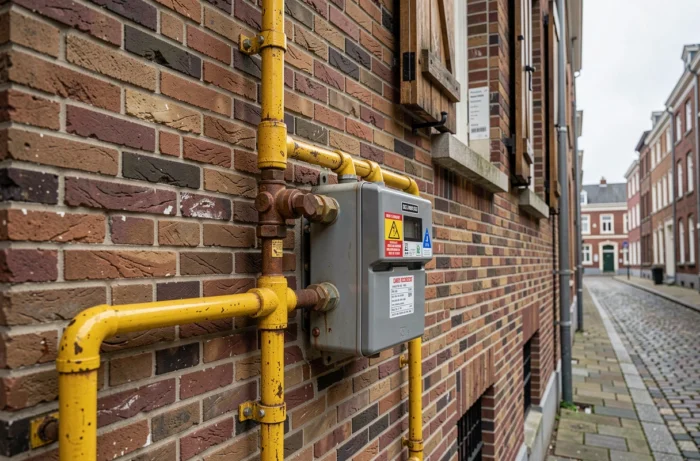
Are you considering building or buying a new property? The rule is clear: gas connections are banned in new constructions in Brussels since 2025. This applies to all projects consisting exclusively of new or equivalent energy performance units.
This ban does not only affect the boiler. It is the connection itself to the distribution network that is no longer permitted for these projects. Gas is considered a fossil fuel incompatible with the energy performance objectives of new buildings.
And for existing buildings?
In an existing home, installing a new condensing gas boiler remains allowed in 2025. If your device breaks down, you can replace it with a recent gas model. However, this option will gradually decrease.
Brussels has already scheduled the next step: starting in 2030, major renovations will also have to do without gas. Permit applications for renovation projects equivalent to new must provide for a heating system capable of producing renewable heat. Gas alone will no longer suffice.
Increase in gas excise taxes: what changes for your bill
Beyond technical rules, it is the economic signal that weighs the most. The latest federal budget agreement provides for an increase in excise taxes on natural gas. For Brussels households that heat with gas (which represent a significant portion of the population), the bill will increase significantly.
Why this increase? The mechanism aims to make decarbonized alternatives more competitive by comparison. The price of gas will continue to increase structurally, not just due to the market, but by political decision.
This price trajectory changes the calculation for a property owner. A condensing gas boiler remains cheaper to purchase than a heat pump, but the operating cost gap is narrowing each year. Over the lifespan of a device (about fifteen years on average), gas is gradually losing its historical price advantage.
Heat pump or hybrid system: realistic options in Brussels
Replacing a gas boiler with a heat pump in a Brussels apartment is not always straightforward. Older buildings, poorly insulated, with high-temperature radiators, pose a real technical challenge.
Here are the options that emerge depending on the type of housing:
- Air-water heat pump: suitable for individual houses or buildings with outdoor space for the unit. It works best in a well-insulated home equipped with low-temperature radiators or underfloor heating.
- Hybrid system (heat pump coupled with a condensing gas boiler): a compromise for existing buildings that are difficult to insulate quickly. The heat pump meets most needs, while the gas boiler takes over during cold spells.
- Connection to a district heating network: Brussels is gradually developing urban networks powered by renewable or recovered sources. This option is currently limited to certain neighborhoods.
The choice depends on existing insulation, available space, and budget. In an apartment building with a collective chimney, switching to an individual solution often requires the agreement of the co-ownership and work on common areas.

Regulatory timeline for gas in Brussels: key dates to remember
To clarify, here are the deadlines that frame the gradual end of gas heating in the Brussels-Capital Region:
- Since January 1, 2025: obligation for feasibility analysis for atmospheric boilers on collective chimneys.
- Since June 1, 2025: ban on installing an oil boiler (unless exempt).
- Since 2025: ban on gas connections in new constructions (new or equivalent energy performance units).
- From 2030: ban on gas alone in major renovations equivalent to new.
Gas remains legal in existing buildings, but its scope of use is reduced each year. Owners who replace their gas boiler today are buying time, not a definitive solution.
If your boiler is less than ten years old and works well, you are not obliged to change it immediately. However, planning the building’s insulation now and assessing the feasibility of a heat pump will prevent you from facing a rushed transition when the rules tighten further. Gas heating in Brussels is not dead in 2025, but its horizon is shortening year by year.