
It’s mid-afternoon, lunch is far behind, and the vending machine in the hallway offers a dozen chocolate bars. The instinct is to grab the first one to hold off until dinner. The problem is that this type of ultra-processed snack only satisfies for a few minutes and often leads to an even stronger second hunger spike. Choosing healthy snacks requires understanding a few simple mechanisms, not becoming a nutritionist.
Ultra-processed snacks and metabolic syndrome: the criterion that labels don’t show
Most snack guides focus on calories or macronutrients. We look at sugar, fat, and sometimes protein content. This instinct isn’t bad, but it overlooks a more crucial parameter for medium-term health: the degree of processing of the food.
A meta-analysis published in 2023 in Frontiers in Nutrition (Shu L. et al.) concludes that a high consumption of ultra-processed foods is significantly associated with an increased risk of metabolic syndrome, even after adjusting for the main lifestyle factors. In practical terms, a pack of industrial cookies showing a reasonable calorie count is still classified as NOVA 4 (ultra-processed), with its additives, emulsifiers, and synthetic flavors.
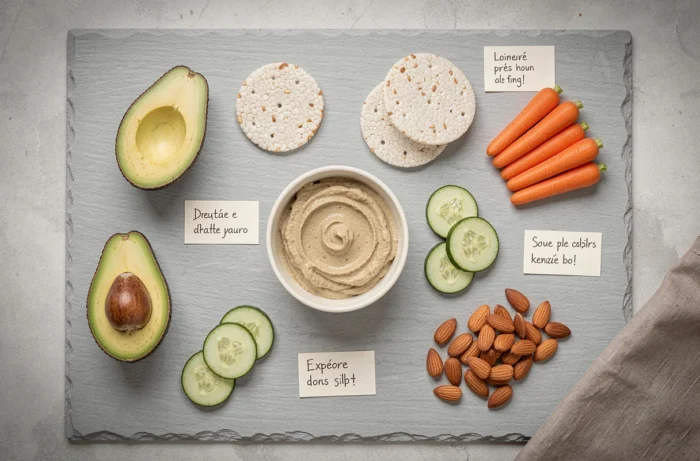
The operational criterion for sorting your snacks is therefore simple: prioritize minimally processed or homemade foods. A handful of nuts, a fresh fruit, plain yogurt, or vegetable sticks with hummus all fall into NOVA 1 or 2 categories. To delve deeper into this selection logic, you can find healthy snacks on Madame Gertrude with detailed criteria and concrete options.

Protein and fiber in a healthy snack: the duo that truly satisfies
We’ve all experienced the snack that lasts no more than twenty minutes. A fruit puree in a pouch, a puffed rice cake, a fruit juice: energy spikes quickly and drops just as fast. This phenomenon is explained by the absence of two elements that slow digestion and stabilize blood sugar levels.
Why combine these two nutrients
Proteins take longer to be broken down by the body, prolonging the feeling of fullness. Fiber, on the other hand, forms a gel in the intestine that slows sugar absorption. Combining protein and fiber in the same snack prevents the blood sugar spike and the subsequent craving.
In practice, you combine a protein-rich food with a fiber-rich food. Here are some combinations that work daily:
- Cheese (about the size of a thumb) with a whole apple or pear, skin included for the fiber.
- Plain Greek yogurt (no added sugar) with a handful of oats and a few raspberries.
- Peanut butter on celery sticks or banana slices, which provide both plant-based protein and soluble fiber.
- Hard-boiled egg accompanied by carrot or cucumber sticks, easy to transport in a sealed container.
Feedback varies on the ideal quantities depending on body types, but the basic principle remains the same: one source of protein and one source of fiber in each snack.
Revised Nutri-Score: what changes for choosing snacks in-store
The Nutri-Score, this colorful indicator placed on packaging in France, is undergoing a recent tightening of its calculation method, with deployment expected between 2025 and 2027. The new scale penalizes products high in sugars, salt, and saturated fats more heavily, which directly impacts industrial savory and sweet snacks.
In practice, some products that previously had a B or C rating could drop to D or even E with the new algorithm. For us consumers, this means that the Nutri-Score becomes a more reliable filter to eliminate false friends among supermarket snacks. A pack of “whole grain” crackers loaded with salt and hydrogenated fats will no longer be able to hide behind a flattering score.
Two useful reflexes in-store: check the updated Nutri-Score (letter and color), then turn the package over to read the ingredient list. If this list exceeds ten components, several of which are incomprehensible, put the product back.
Healthy snack daily: organization and common pitfalls
Knowing what to eat is one thing, having the right snack on hand at the right time is another. The main obstacle is availability. We end up snacking on cookies because they are there, not because we chose them.
Preparing snacks in advance
Two hours on Sunday evening is enough to prepare snacks for the week. We chop raw vegetables, portion out dried fruits and nuts into bags, and make homemade muffins using oats and mashed bananas. Everything stores easily in the refrigerator or a dry cupboard.
Common pitfalls to avoid
The “protein snacks” sold in supermarkets are often ultra-processed products disguised as healthy food. The same logic applies to chocolate-coated cereal bars: nutritional marketing does not replace reading the composition.
- Puffed rice cakes have a very high glycemic index despite their low caloric intake; they do not satisfy.
- Industrial smoothies often contain as much sugar as a soda, without the fiber of the whole fruit.
- Dried fruits are nutritious but very energy-dense: a small handful is enough; the whole bag equals a meal.
The choice of a healthy snack relies on three concrete filters: a low degree of processing, the combined presence of protein and fiber, and a short, readable ingredient list. The revised Nutri-Score will soon facilitate this sorting in-store, but nothing replaces the habit of flipping the packaging. Preparing your snacks in advance remains the most reliable method to avoid giving in to the vending machine in the hallway.