An electrical panel overheating behind a drywall, an overloaded power strip under a desk, a chewed cable in a false ceiling: on the ground, fire starts related to electricity do not give warnings. They are often grouped under the term “electrical fire class,” but this expression conceals a more nuanced normative reality than it seems.
Electrical fire and standard NF EN 2: why the “E class” no longer exists
In interventions or training, we still hear about “E class” to refer to fires of electrical origin. On paper, this class has disappeared from the European standard NF EN 2. The electrical fire is not a standalone fire class: it is a fire of class A, B, or C whose ignition source is an electrical fault.
What makes these fires specific is not the nature of the fuel (wood, plastic, insulation), but the presence of voltage. A PVC-sheathed cable that ignites produces a solid fire (class A). The peculiarity is that the installation remains potentially live during combustion.
The real danger lies in the conductivity of the extinguishing agent. Spraying water on a powered electrical panel exposes one to electrocution and electrical arcs. This is why extinguishers carry a maximum voltage mention (often up to 1,000 V) and why CO2 or powder is preferred for this type of incident.
To learn everything about the electrical fire class, one must first understand this distinction between the nature of the fuel and the energy source.
Conductivity and electrical arc: the risk that extinguishers alone cannot resolve
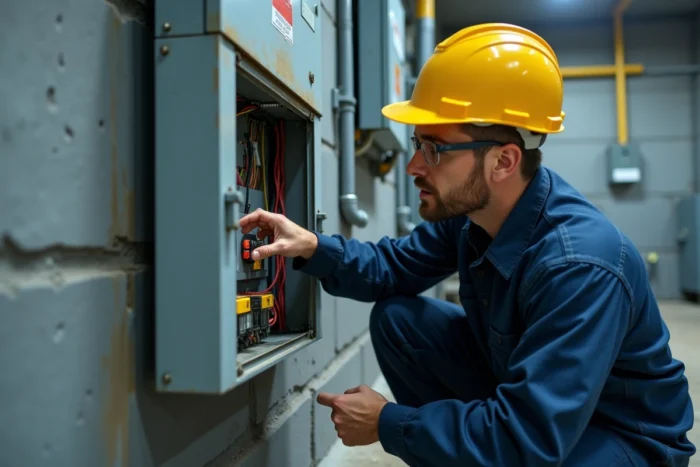
On a construction site or in a technical room, the first thing to do when faced with a fire starting on an electrical cabinet is to cut the power. As long as the current flows, any conductive agent becomes a vector for electrocution for the responder.
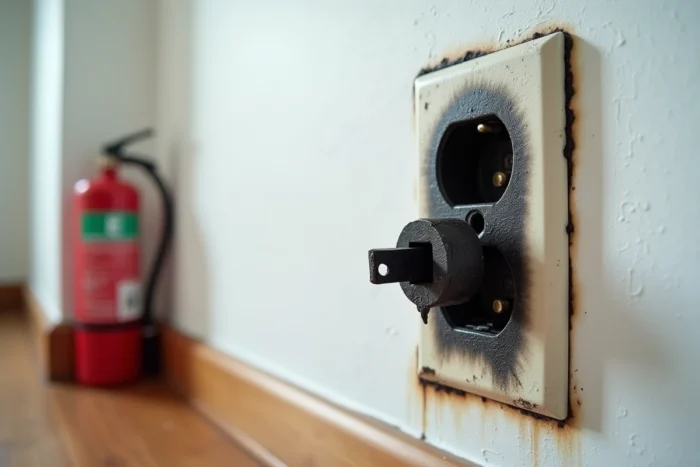
The electrical arc poses an additional risk that is often underestimated. When a short circuit occurs in a confined space (enclosure, duct, false floor), the arc can reach extreme temperatures and project molten metal particles. We are no longer just talking about flames, but about a thermal flash capable of causing severe burns at a distance.
Which extinguisher to use on an electrical fire
The choice of extinguisher depends on the voltage and the fuel involved:
- The CO2 extinguisher (carbon dioxide) is the most suitable for electrical rooms. It leaves no residue, does not conduct electricity, and suffocates the fire by removing oxygen. Its range is limited, which requires quick intervention.
- The ABC powder extinguisher covers a wide spectrum (solids, liquids, gases) and can be used on live equipment up to 1,000 V. The powder can damage electronic components, which is problematic in server rooms or transformer stations.
- Water sprayed with an additive can be used on certain electrical fires if the extinguisher carries the corresponding voltage mention, but it is generally avoided in high-voltage environments.
In all cases, cutting the power before using an extinguisher remains the top priority when it is technically possible.
Frequent causes of electrical fires: what we find on the ground
Intervention feedback shows recurring patterns. The same causes are found in old homes as well as in poorly maintained professional premises.
Overloads on power strips top the list. Plugging a space heater into a low-quality power strip exceeds the nominal capacity of the circuit. The plastic heats up, melts, and the fire starts. In professional environments, open-plan offices sometimes combine monitors, chargers, and space heaters on a single circuit not sized for this load.
Old wiring represents another recurring factor. Installations predating current standards use conductors whose insulation degrades over time. Loose connections in junction boxes create invisible hot spots, sometimes for months, before a flame appears.
Hot spots and infrared thermography
Infrared thermography allows for the detection of these abnormal heatings before they escalate. By passing a thermal camera over an electrical panel, one can immediately spot connections that are heating beyond normal levels. Early detection of a hot spot prevents a costly incident. This technique is becoming common in fire safety audits in industrial settings but remains little used by individuals.
Electrical fire prevention: actions that change the risk level
Prevention involves simple actions that are often overlooked. We are not talking about theoretical recommendations, but about what makes a concrete difference in a real installation.
- Have the electrical installation checked by a qualified professional, especially in buildings over fifteen years old. The mandatory electrical diagnosis during a real estate sale does not cover everything: it signals visible anomalies but does not test the entire network under load.
- Avoid cascading power strips. One circuit, one outlet, one high-power device. Extension cords should be fully unwound to prevent heating due to inductive effect.
- Install 30 mA differential circuit breakers on all circuits. This device cuts power as soon as it detects a current leak, reducing the risk of prolonged heating.
- Clear the area around electrical panels. Storing cardboard or flammable products against an electrical cabinet provides immediate fuel in case of a fault.
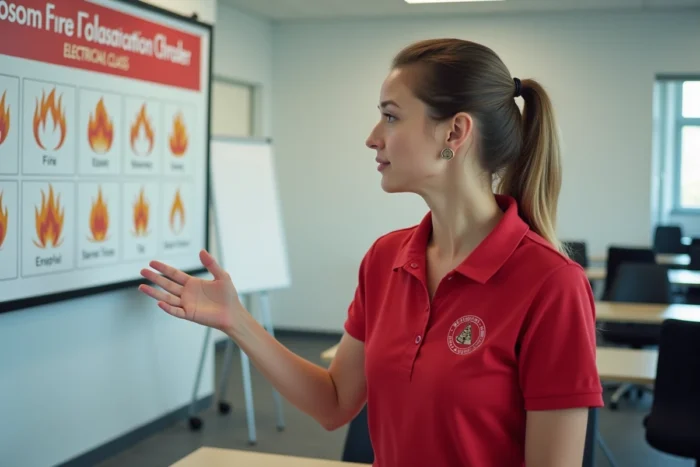
In professional settings, training staff in the use of extinguishers and emergency shutdown constitutes a direct complement to these material measures. Articles R.4227-28 to R.4227-39 of the Labor Code require employers to implement appropriate fire prevention measures.
L class for lithium-ion batteries: the new reality of electrical fire
The ISO 3941 standard introduces an L fire class dedicated to lithium-ion batteries. This is not a regulatory detail: with the increasing number of electric vehicles, scooters, domestic energy storage systems, and inverters, lithium battery fires have become a significant safety issue.
The thermal runaway of a lithium-ion battery produces the release of flammable and toxic gases that are difficult to control with conventional extinguishing agents. Feedback varies on this point depending on configurations, but a CO2 extinguisher alone is generally not sufficient to stop the chain reaction inside the cells.
Specific training on fire risks related to electric vehicle charging infrastructure (IRVE) is beginning to be structured. It covers intervention procedures adapted to this type of combustion, where prolonged cooling with water often remains the only option to contain thermal runaway.
The line between classic electrical fire and lithium battery fire is becoming clearly defined. The extinguishing methods, intervention procedures, and protective equipment differ. Integrating this distinction into prevention plans becomes an operational necessity for any site that stores or charges batteries.