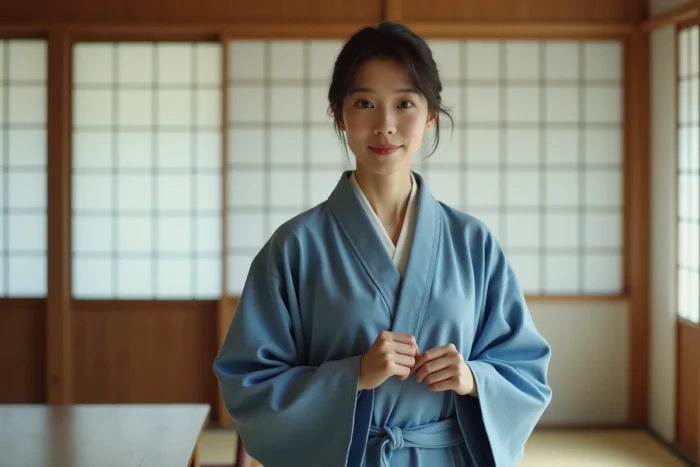
Opening your hotel room in Japan and finding a nightwear laid out on the bed is part of the experience. Lightweight cotton yukata, two-piece room wear sets, or short-sleeved jinbei: the provided garment varies from one establishment to another, as do the rules surrounding its use.
Understanding what is available, where to wear it, and how to put it on correctly avoids misunderstandings in a country where dress codes remain precise, even in casual contexts.
Yukata, jinbei, or room wear: how the type of accommodation makes a difference
The most common confusion among travelers concerns the name of the garment. The term “pajamas” actually covers several distinct realities depending on whether one is staying in a ryokan, a chain hotel, or a capsule hotel.
In a traditional ryokan or an establishment with an onsen, the yukata is predominant. It is a lightweight cotton kimono worn with an obi (belt). Some ryokan also offer a jinbei, a short-sleeved top-and-bottom set, more suitable for warm months.
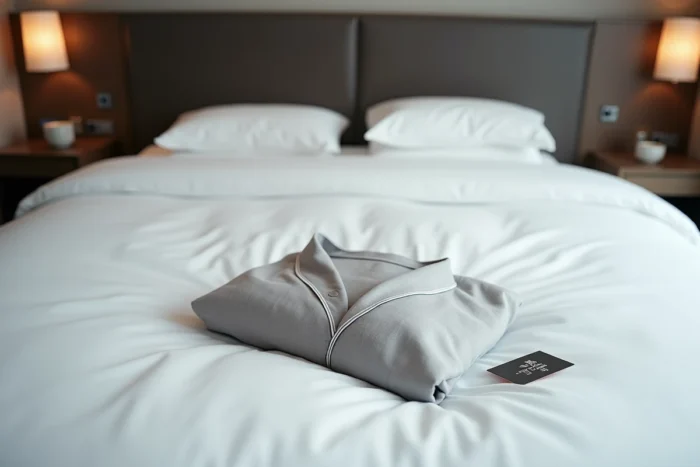
Urban chain hotels (like business hotels) typically provide room wear, which is a set of pants and tunic made of fine fabric, visually closer to Western pajamas. Capsule hotels generally provide a similar set, often for single use.
Sizes are not always suited to Western body types. Several chains offer sizes ranging from S to L, but availability depends on the establishment. In case of doubt, checking at the reception remains the most reliable method. The pajamas provided in Japanese hotels meet standards that vary by category and region.
Left panel over the right: the yukata rule that guides often overlook
Travel articles often mention the existence of a correct way to put on the yukata. Few explain why this rule is non-negotiable.
The left panel must always go over the right panel. The reverse, right over left, is reserved for dressing the deceased during funerals. Making a mistake in the hallway of a hotel or in a thermal space does not result in direct reprimand but causes discomfort among Japanese guests who observe it.
The simplest mnemonic: once the yukata is on, the right hand should be able to slip into the opening at the chest level, like in the inner pocket of a jacket. If the left hand goes in, the orientation is reversed.
The obi and the knot
The obi is tied at the waist, not on the hips. A simple knot is sufficient. In most ryokan, staff offer a quick demonstration upon arrival. Don’t hesitate to ask for it rather than improvising: a poorly adjusted yukata opens with every movement, complicating circulation in shared spaces.
Hotel pajamas in Japan in common areas: where tolerance ends
The question of the allowed perimeter generates the most confusion. Wearing rules vary from one establishment to another, sometimes from one floor to another within the same hotel.
In ryokan with onsen, the yukata is generally tolerated in almost all areas: hallways, dining rooms, baths, indoor gardens. Some ryokan even accept it for short outings in the surrounding neighborhood, especially in hot spring towns like Kinosaki Onsen, where strolling in yukata is part of the local experience.
In urban business hotels, the situation is more restrictive. Room wear is confined to the room and, sometimes, to the bath floor. The lobby, main restaurant, and meeting rooms are areas where nightwear is not accepted. Pictograms or signs in English often indicate these restrictions, but not systematically.
- Check the signage in the elevator and at the restaurant entrance: a crossed-out yukata pictogram indicates a prohibited area
- Observe other Japanese guests: if they are wearing their city clothes in a given space, do the same
- In case of doubt, ask at the reception using the term “room wear” (ルームウェア), understood in most establishments
Keep or return the pajamas: what hotels really expect
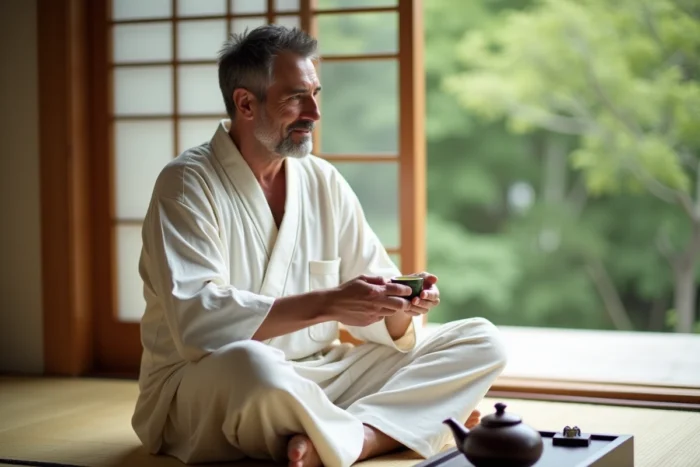
The question of whether one can take the nightwear after the stay often comes up in travel forums. The vast majority of establishments consider pajamas to be reusable items, washed and made available for the next guest. Keeping it without permission amounts to taking hotel property.
Some capsule hotels or budget chains use single-use sets, similar to disposable textiles. In this specific case, the question does not arise. However, in ryokan and mid-range to upscale hotels, the yukata or room wear must be left in the room at check-out.
Some hotel chains offer new versions of their nightwear for sale, available at the reception or in an adjacent shop. This practice remains minority but is tending to grow, especially in establishments that have identified a demand from foreign clientele.
Packing: bring your own pajamas or rely on the hotel
For a trip combining several types of accommodation, the answer depends on the itinerary. A traveler alternating between ryokan and urban hotels will find nightwear in almost all their stops. Bringing personal pajamas is only useful in two cases: a body type very different from standard Japanese sizes, or a stay in a youth hostel where no nightwear is provided.
The yukata is an integral part of Japanese hospitality, just like the slippers at the entrance or the tea in the room. Refusing to wear it is not an offense, but putting it on correctly remains a gesture of adaptation appreciated by hosts. The only real faux pas is the reversed wearing direction, and it can be corrected in three seconds.