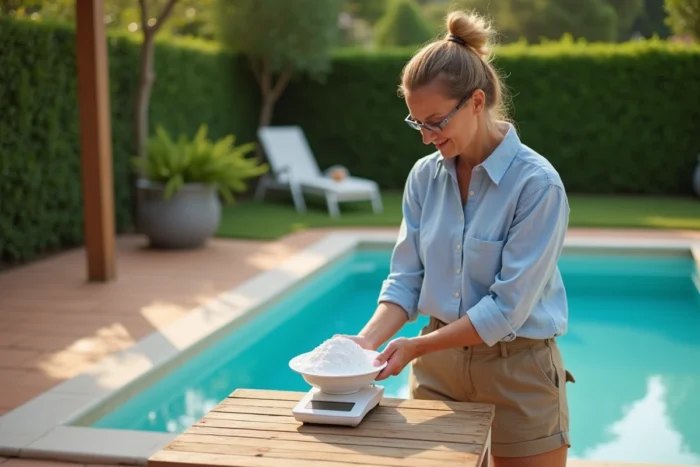
Your pool water is turning green, you’re looking for a natural solution and you come across sodium percarbonate. The product is often presented as an eco-friendly pH corrector. The reality is more nuanced, and misusing it can destabilize your pool instead of improving it.
Sodium percarbonate and pool pH: what the product really does
Sodium percarbonate is a compound that, when in contact with water, decomposes into sodium carbonate and hydrogen peroxide. Hydrogen peroxide (active oxygen) acts as a disinfectant and oxidizer. Sodium carbonate, on the other hand, is an alkaline product that tends to raise the pH.
It is this carbonate fraction that creates confusion. The pH increases after adding percarbonate, and many conclude that the product is used to regulate pH. In practice, the pH increase is a side effect, not the main function.
Recently updated technical guides on pool chemistry do not list percarbonate among the reference pH correctors. Only sodium carbonate (pH+) and sodium bicarbonate are recommended for controlled pH adjustment. The reason is simple: with percarbonate, you do not precisely control the amount of carbonate released, making the dosage approximate.
Before choosing this product for your pool, it is useful to understand how to use sodium percarbonate in pools according to its true properties, without assigning it a role that it does not reliably fulfill.
Shock treatment against algae: the true domain of percarbonate
Have you ever noticed that the water becomes cloudy or greenish after a storm or a period of intense heat? This is a sign of algae or organic matter proliferation. Sodium percarbonate excels in this specific case.
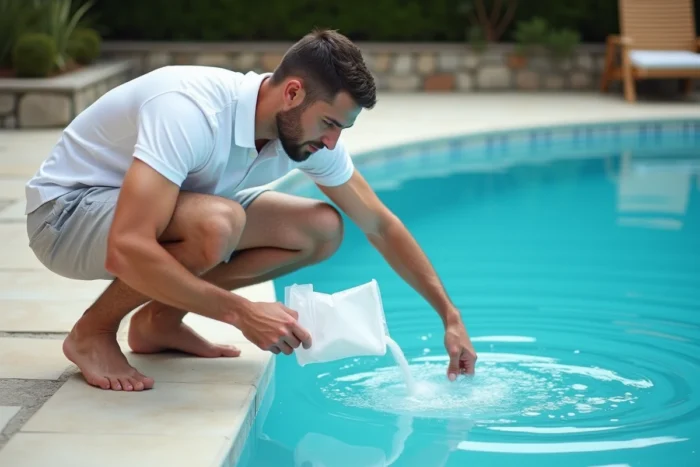
The active oxygen released during dissolution oxidizes algae and organic residues. The result is visible within a few hours: the water clears up. This shock treatment without chlorine is well-suited for people sensitive to chlorinated products or for pools treated with active oxygen.
What to check before a shock treatment
- Measure the pH and TAC (total alkalinity) before adding anything. A shock treatment with percarbonate will raise the pH, sometimes above the ideal range of 7.2 to 7.4.
- Ensure that the filtration runs continuously during and after the addition, to distribute the product and avoid local concentrations.
- Dissolve the percarbonate in a bucket of warm water before pouring it into the pool. Undissolved powder can discolor a liner or coating.
Therefore, percarbonate is a spot oxidizer, not a regular maintenance product for pH. Using it every week to “maintain” pH would be like overdosing a product for which it is not intended.
Alkalinity and pH: why correct TAC first
One point that articles on percarbonate rarely address: pH stability primarily depends on TAC, total alkalinity. TAC measures the water’s ability to resist pH fluctuations. If TAC is too low, pH fluctuates constantly, regardless of the correcting product used.
Why does this detail change everything? Because sodium bicarbonate raises TAC and stabilizes pH at the same time. Percarbonate, on the other hand, releases sodium carbonate that mainly affects pH without stabilizing TAC in the same way.
Before trying to raise a low pH, always test the alkalinity. If it is insufficient, food-grade sodium bicarbonate (available in supermarkets) is the appropriate product. pH will naturally rise once TAC is restored, and it will remain stable longer.
When percarbonate does more harm than good
Adding percarbonate to a pool with correct TAC but slightly low pH can cause a pH rebound above 7.6. At this level, chlorine loses a significant part of its disinfecting power. You then end up with water that has too high a pH, ineffective chlorine, and the need to add an acidic product to bring it down.
This correction-overcompensation cycle is the classic trap of a poor product choice. Percarbonate is not to blame; it is its out-of-context use that is problematic.
Concrete protocol: which product for which pH problem in pools
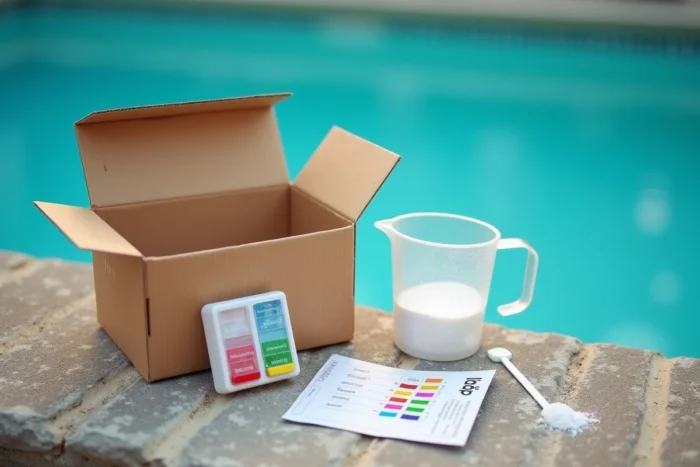
Rather than a table of theoretical dosages, here is a simple decision tree based on the actual situation of your water.
Low pH (below 7.2) and low TAC: use sodium bicarbonate. It raises both parameters simultaneously. Add in small doses, retest after a few hours of filtration.
Low pH (below 7.2) and correct TAC: use sodium carbonate (pH+), sold in specialized pool stores. It targets only pH without significantly altering alkalinity.
Green or cloudy water with correct pH: this is the only case where sodium percarbonate is fully appropriate. It oxidizes organic matter and algae without resorting to shock chlorine. Plan to retest pH after treatment, as it will rise.
Green water and low pH: percarbonate can serve a dual purpose here, oxidizing algae and slightly raising pH. But if the pH gap is too large, supplement with bicarbonate to stabilize the result.
The mistake not to repeat
Never correct pH and never perform a shock treatment in a single massive operation. Proceed in stages, with a test between each addition. Online calculators for pH dosing use only sodium carbonate as a reference, not percarbonate, confirming that the latter is not calibrated for precise adjustment.
Sodium percarbonate remains a useful product in a pool maintenance kit, provided it is assigned the right task. Oxidizing algae and occasional cleaning, yes. Fine and regular pH correction, no. For this task, sodium bicarbonate and sodium carbonate are the appropriate tools, more predictable and better documented in water treatment protocols.