
How to measure the scope of a manga genre that most cultural analyses prefer to bypass? Hentai, the adult segment of Japanese manga, is undergoing a profound transformation. With the digital shift, the crisis of independent publishers, and a changing legal framework, the usual benchmarks are no longer sufficient to understand what is happening around this production.
Japanese erotic manga: physical market vs digital
The defining fact of recent years in manga, across all categories, is the dominance of digital. According to the Research Institute for Publications, digital titles will account for 76.1% of the manga market in Japan by 2025, even as the total market contracts for the first time in eight years.
This shift directly impacts adult content. Physical sales in konbini and specialized bookstores are declining in favor of online platforms, where hentai finds a more discreet and broader distribution channel.
| Distribution Channel | Recent Trend | Impact on Hentai |
|---|---|---|
| Specialized bookstores / konbini | Decline in physical sales | Reduced shelf visibility |
| Japanese digital platforms | Continuous growth, majority share | Simplified access, broader catalogs |
| Independent publishers (France) | Overproduction, bookstore closures | Fragilization of small niche print runs |
The hentai segment, historically dependent on specialized distribution channels and limited print runs, is being hit hard by this reconfiguration. Understanding hentai and hentai manga requires taking this economic reality into account, well beyond the mere content of the works.

Independent hentai publishers in France: a niche under pressure
In France, the manga market publishes about 250 volumes per month in bookstores. This overproduction, noted by several independent publishers before Japan Expo, creates an effect of invisibility for niche catalogs.
Publishers specializing in adult manga, such as NihoNiba (Euphor group) or Hot Manga, face a double constraint. The physical distribution network is shrinking, and competition from foreign digital platforms captures part of the readership.
What weakens small hentai publishers
- A contracting network of specialized bookstores, with regular closures of outlets dedicated to adult manga
- Low print runs by nature: Hot Manga’s Doujinshi collection, for example, offers unique print runs limited to 1,500 copies per title
- Reduced visibility at conventions: at Japan Expo, hentai remains confined to specific areas, far from the main aisles
Despite these difficulties, the segment is not disappearing. Hot Manga planned eight releases for August 2026, including four in its Doujinshi collection, with refined formats (matte lamination, selective varnish, no censorship). Editorial quality partially compensates for the reduction in volumes.
Hentai and the French legal framework: shifting lines
The other angle rarely addressed in articles about the genre concerns the legal framework. In France, the repression of sexually explicit content is evolving rapidly, and adult manga is not exempt from these movements.
The issue of pornographic deepfakes, framed by Article 226-8-1 of the Penal Code, has been the subject of decisions by the criminal chamber between 2022 and 2026. While this legislation primarily targets content generated by artificial intelligence, it redefines the scope of what constitutes illicit content in terms of sexual representation.
For hentai, the boundary between drawn fiction and reprehensible content remains an unsettled legal issue. Works featuring fictional characters in explicit situations do not fall under the same regime as content involving real people, but regulatory pressure tends to tighten the criteria for assessment.
Differences between Japan and France
In Japan, partial censorship of genitalia (pixelation) remains the legal norm in adult publications. French publishers importing these titles often choose to publish the uncensored versions, raising questions of compliance with local law.
Conversely, Japan has recently considered creating a common manga platform for the international market, which could alter the distribution channels for adult content for export.
Origins of the hentai genre: from shunga to digital doujinshi
Hentai does not emerge in a cultural vacuum. Its roots lie in shunga, the erotic prints of the Edo period, of which Hokusai’s The Dream of the Fisherman’s Wife remains the most famous example. The link between shunga and modern hentai illustrates a continuity of several centuries in explicit representation in Japan.
The term “hentai” itself literally means “perversion” or “transformation” in Japanese. Its use to refer to pornographic manga is primarily Western. In Japan, terms like ero-manga or seinen for adults are more commonly used, depending on the degree of explicitness.
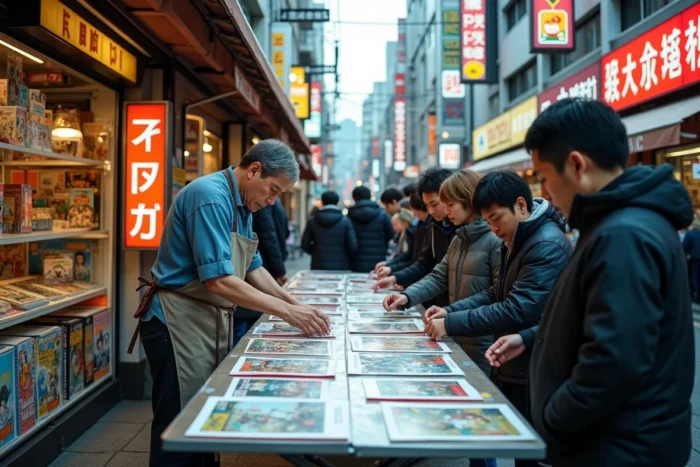
Contemporary production is structured around two circuits. Commercial manga, published by publishers like Wanimagazine, and doujinshi, self-published by circles of independent authors. This second circuit, long marginal in export, is gaining visibility thanks to digital platforms and Western publishers who acquire rights directly from creators.
The market for Japanese adult manga accompanies the changes in the global sector. The contraction of the physical market, the rise of digital, and the gradual tightening of national legal frameworks are reshaping the contours of a genre that remains, despite its sultry reputation, a structured editorial segment with its own production and distribution codes.