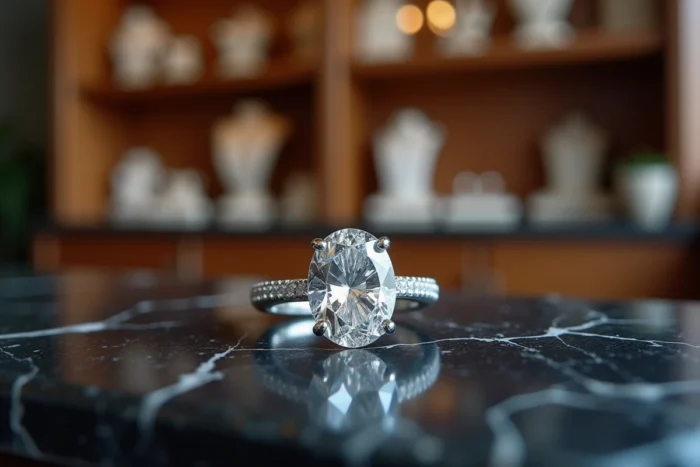
Some rings transcend the status of jewelry to become collectible objects sought after by the wealthiest individuals. Their price is not only determined by the size of the stone, but by a set of factors that ordinary buyers rarely consider: purity, color, historical provenance, and rarity in the global market. Understanding what propels a ring beyond the ten million dollar mark requires looking beyond mere carat weight.
What Really Sets the Price of a Record Ring
Before even browsing a ranking, one must grasp the mechanisms that drive up an auction. Two diamonds of identical size can sell for radically different prices. Why such a gap?
The answer lies in four criteria, often summarized under the name “4C” in the world of jewelry.
- Carat (weight): the heavier the stone, the price per carat increases exponentially, not linearly. Doubling the weight can multiply the value by much more than two.
- Clarity and color: a diamond rated “internally flawless” (with no visible inclusions) in a deep pink or blue hue reaches new heights, as these combinations are exceptionally rare in nature.
- Cut: the quality of the cut determines the brilliance. A poorly cut stone loses a significant part of its sparkle, and thus its market value.
- Provenance and history: a diamond that once belonged to a royal figure or has passed through several centuries of private collections benefits from a premium of notoriety at auctions.
These criteria explain why some rings reach amounts that even larger diamonds cannot compete with. The ranking of the most expensive rings in the world illustrates this logic where rarity outweighs raw size.
Pink and Blue Diamonds: Why These Colors Dominate Records
You may have noticed that the most expensive rings sold at auction often feature pink or blue diamonds. This is not an aesthetic coincidence; it is a matter of geology.
Pink diamonds primarily come from deposits with extremely limited production. Their geological rarity drives prices well beyond those of white diamonds, even those of larger size. A pink diamond of a few carats can exceed in value a colorless diamond two or three times heavier.
Blue diamonds, colored by traces of boron trapped during their formation, are even rarer. When a large specimen with intense color appears on the market, jewelry houses like Graff engage in fierce competition to acquire it.
The Case of the Pink Star
The Pink Star remains one of the most famous stones on the market. This oval-cut pink diamond achieved a sale price that marked the history of jewelry auctions. Its “fancy vivid pink” color places it in the most sought-after category by collectors.
What makes this stone so special is the combination of its size, purity, and color intensity. Finding these three qualities combined in a single natural diamond is a statistical exception.
Traceability of Precious Stones: A Recent Requirement That Changes the Game
The luxury ring market is no longer limited to beauty and price. Since January 1, 2026, the 2024 Code of Practices from the Responsible Jewellery Council imposes enhanced traceability obligations. Rubies, sapphires, and emeralds are now subject to the same controls as diamonds.
In practical terms, jewelers must implement a five-step system aligned with the OECD framework: internal management, risk analysis, appropriate response, independent audits, and annual reporting. This regulation directly affects the most expensive rings, whose stones often pass through several countries before reaching a showcase or auction room.
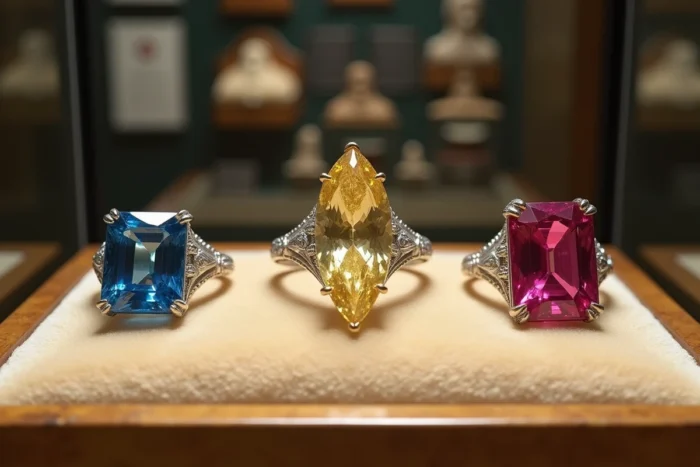
Synthetic Diamonds and Certification
Synthetic diamonds also fall within the scope of these new standards. Houses selling record-priced rings must now clearly distinguish the natural or synthetic origin of each stone. A certified natural diamond with complete traceability is worth significantly more than an equivalent without documentation.
For buyers at the top of the market, this transparency becomes a decision-making criterion. A ring sold for several million dollars without a solid provenance certificate loses attractiveness during future resales.
Jewelry Houses and Auctions: The Role of Major Signatures
The most expensive rings are not always created by well-known brands. Some historical pieces change hands among private collectors without ever passing through a luxury showcase. However, when a house like Graff recuts or sets an exceptional diamond, it adds considerable brand value.
Graff has acquired and recut several of the world’s most famous diamonds, transforming rough stones into collectible jewelry. The Wittelsbach-Graff, for example, was recut to enhance its clarity, a decision that sparked debate among gemologists but also increased its value.
The Weight of Auction Houses
Auction houses play a central role. They authenticate, certify, and showcase pieces before a select audience of wealthy collectors. The context of the sale influences the final price as much as the stone itself.
A ring presented at a high-profile auction in Geneva, with a catalog detailing its history over several pages, sells better than the same stone offered in a less prestigious setting. The narrative surrounding the jewel is an integral part of its value.
The market for the most expensive rings in the world ultimately relies on a balance between natural rarity, the jeweler’s craftsmanship, and commercial staging. The new traceability requirements add an additional layer: in the future, owning an exceptional diamond will no longer be enough. It will also be necessary to prove where it comes from, how it was mined, and through whose hands it has passed.