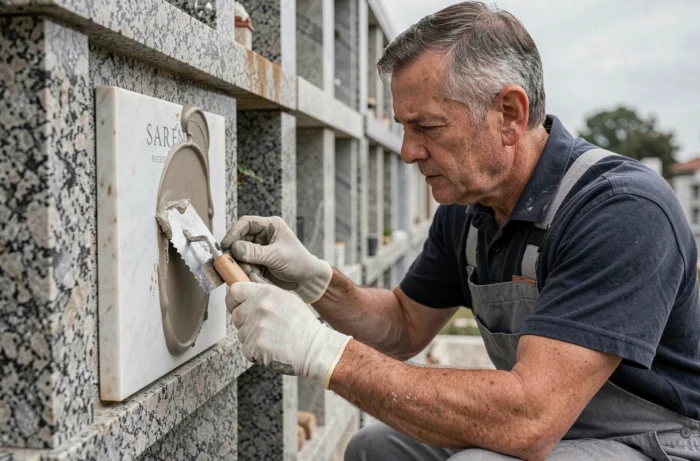
Fixing a plaque on a columbarium is not just about applying a dot of glue and pressing for a few seconds. The support is vertical, often made of polished granite, and is constantly exposed to the elements. An unsuitable adhesive can fail within months due to frost or heat. Understanding the nature of the support and choosing the right adhesive makes all the difference between a plaque that lasts for years and one that is found on the ground.
Glue Class for Columbarium: What Standards Require Outdoors
Online guides often recommend a “special stone glue” or an “outdoor silicone sealant” without further details. The problem is that the glued installation of natural stone outdoors is governed by specific technical texts.
The DTU 52.2 and DTU 55.2, published in coordination with AFNOR and CSTB, define the classes of adhesives to be used according to the type of support, the weight of the element, and the exposure. For a vertical outdoor application like a columbarium, these texts recommend C2S1 or C2S2 class adhesive mortars (EN 12004 standard). For stain-sensitive stones, a reactive R2 class adhesive is preferable.
In practical terms, this means that a tube of neoprene bought at a supermarket or standard silicone is not compliant with the best practices for this type of installation. You have the choice between a suitable adhesive mortar and a two-component epoxy resin, but the determining factor remains the performance class, not the price or brand.
Before buying anything, it is useful to know how to glue a columbarium plaque with tombstone adhesive while considering these technical requirements, which apply to both traditional graves and columbarium niches.
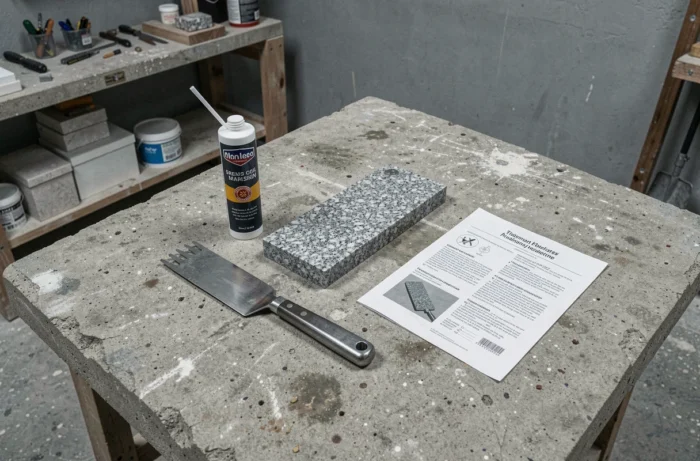
Polished Granite, Raw Marble, Metal: Adapting the Adhesive to the Plaque Material
Why can two plaques glued with the same product have very different lifespans? Because the material of the plaque and that of the support do not react the same way to the adhesive.
Granite or Natural Stone Plaque
Polished granite offers very little mechanical grip. The surface is smooth, almost impermeable. A C2S1 adhesive mortar with double gluing works well on raw granite, but on polished granite, a two-component epoxy adhesive offers significantly superior adhesion. Epoxy creates a chemical bond with the surface, independent of porosity.
Glass or Plexiglass Plaque
Glass is a special case. Standard adhesive mortars do not adhere to glass. A flexible MS polymer sealant or a clear epoxy adhesive is required. Flexibility is an asset, as glass does not tolerate thermal expansion stresses.
Metal Plaque (Bronze, Aluminum, Stainless Steel)
Metal expands more than stone due to heat. A flexible R2 class adhesive absorbs differential movements between the plaque and the support without detaching. A rigid sealant cracks and fails within a few seasons.
- Polished granite: prefer a two-component epoxy resin to compensate for the lack of porosity.
- Glass or plexiglass: MS polymer sealant or clear epoxy, never mineral adhesive mortar.
- Metal (bronze, stainless steel): flexible R2 class adhesive to absorb thermal expansion.
- Limestone or marble: suitable C2S2 adhesive mortar, ensuring that the product does not stain light stones.
Preparing the Support on a Columbarium: Mistakes That Ruin Everything
The most effective adhesive never compensates for a poorly prepared surface. On a columbarium, the vertical granite support is often covered with an invisible film of dust, moss, or limescale residue left by rain.
Cleaning the bonding area with isopropyl alcohol is the minimum action. Soapy water leaves a greasy film. White spirit can stain certain stones. Isopropyl alcohol degreases without residue and evaporates completely.
After cleaning, the surface must dry completely. Gluing on a damp support, even slightly, can halve the adhesive’s strength or more, depending on the manufacturers. In winter or foggy weather, drying with a clean cloth followed by a wait of several hours is preferable.
Light Sanding, an Underestimated Action
On polished granite, light sanding with fine-grit sandpaper creates micro-scratches invisible to the naked eye. These micro-scratches increase the adhesive’s grip surface. This discreet sanding makes the difference between a bond that holds and one that slips at the first freeze-thaw cycle.
Be careful to sand only the exact area where the plaque will be placed, not beyond. Sanding marks on the polished granite of the columbarium would be visible and difficult to correct.
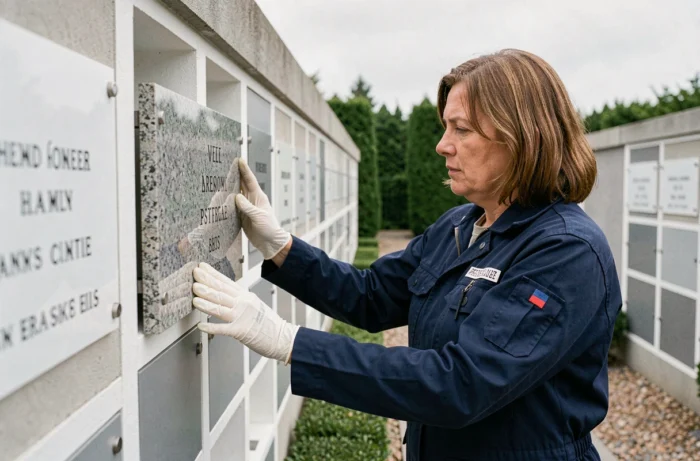
Vertical Installation Technique: Holding and Setting Time on a Columbarium
You have cleaned, sanded, and chosen the right adhesive. The next step is the installation process, which on a vertical surface requires a bit of method.
Apply the adhesive in parallel beads on the back of the plaque, not in a single central point. The beads allow air to escape when you press the plaque against the support. A single central point traps air bubbles that weaken the bond.
Keep the plaque under pressure for the time indicated by the manufacturer, usually several minutes. On a vertical surface, gravity works against you. A strong masking tape, placed in a cross pattern on the plaque and secured to the columbarium, maintains pressure without you having to stay in place.
- Apply the adhesive in regular beads, never in a single central blob.
- Press firmly to expel air bubbles.
- Hold with strong masking tape during the initial setting.
- Do not touch or adjust the plaque once positioned: any movement breaks the beginning of polymerization.
- Respect the full curing time (often several days) before considering the installation complete.
Outdoor temperature also plays a role. Most epoxy adhesives and adhesive mortars do not cure well below five degrees. Planning the installation on a dry, mild day remains the best investment of time.
One last point rarely mentioned: professional stonemasons are increasingly using two-component epoxy resins for structural bonding on columbariums, rather than traditional sealants. This choice reflects the specific constraints of vertical outdoor installation, where mechanical strength takes precedence over ease of application. Choosing the right product from the start avoids the disappointment of finding a detached plaque a few months later.