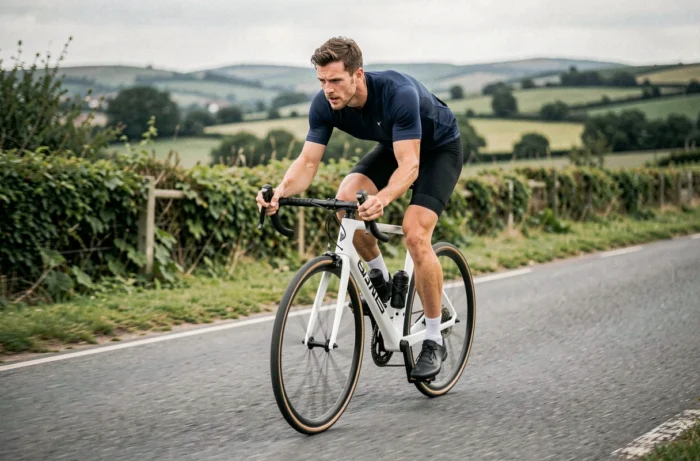
The Triban RC120 occupies a special place in the entry-level road bike landscape. At Decathlon, the Triban brand is gradually refocusing on a few accessible models, while Van Rysel is gaining strength in the evolving road and gravel segments. This repositioning changes the game for cyclists comparing options within the same budget.
Thru-axles vs quick releases: an underestimated technical gap
The wheel attachment system is a concrete point of comparison that impacts the daily use of an entry-level road bike.
The Triban RC120 uses classic quick releases. Its direct competitors, such as the Van Rysel EDR AF, adopt thru-axles. The difference may seem minor on paper, but it has concrete consequences. A thru-axle offers superior rigidity at the hub, which improves disc brake precision and stability while descending.
For a beginner, the quick release is easier to handle during a flat tire. However, thru-axles are becoming more common in the market, including in entry-level models. A cyclist selling their bike after two seasons will find it easier to attract buyers with a model equipped with thru-axles, which have become the norm. When detailing the Triban RC120 match against its competitors, this point regularly comes up in user feedback.
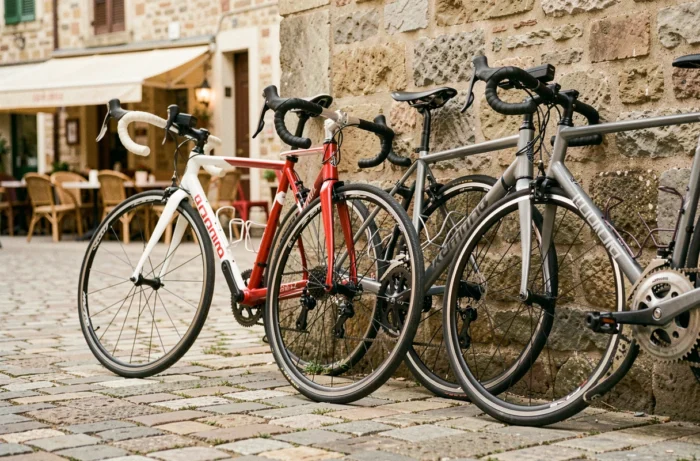
Derailleur hanger of the Triban RC120: a trap for beginners
On the RC120, the derailleur hanger is integrated into the frame. On the Van Rysel EDR AF, it is sacrificial and replaceable. The distinction may seem technical, but it has a direct impact on the wallet.
A simple fall, a bike that tips over on the drivetrain side in a parking lot: the derailleur hanger absorbs the shock first. On a model with a replaceable hanger, the repair costs a few euros and takes just a few minutes. On the RC120, a bent hanger may require a more extensive repair, or even a frame replacement in the worst-case scenario.
For a cyclist just starting out and prone to handling mishaps, this design detail is worth considering before purchase. A replaceable sacrificial hanger protects the investment in the long term.
Carbon fork and disc brakes at this price: what it really means
The RC120 features a carbon fork and mechanical disc brakes. At this price level, it’s a frequently highlighted selling point. The carbon fork better filters vibrations than an aluminum fork, improving comfort on long rides.
Mechanical disc brakes offer more consistent braking in the rain than rim brakes. The shift to disc brakes in entry-level models is indeed a fundamental trend in the road bike market. Some cyclists find the bite of mechanical discs sufficient, while others prefer to save up for hydraulic options, available on slightly higher-priced models.
The RC120’s competitors in the same price range offer comparable equipment. The differentiating criteria then play out in other aspects:
- The maximum tire width accepted by the frame, which affects comfort and versatility on rough roads
- The number of gears and the cassette spacing, which determine ease of climbing
- The quality of the original wheels, often the first component to upgrade on an entry-level bike
Triban and Van Rysel positioning: a range in full reorganization
The boundary between Triban and Van Rysel at Decathlon has been redrawn in recent years. Iconic models like the Triban GRVL 120 and the Triban RC 520 Gravel have been removed from the catalog, replaced by Van Rysel GRVL AF models. Only one model has retained the Triban name in the high-end range (the GRVL 900 titanium).
This reorganization positions the RC120 as the entry-level road bike in the Decathlon ecosystem. Van Rysel takes over as soon as the cyclist wants to upgrade. For the buyer, this means that the RC120 is not intended for indefinite evolution: its role is to facilitate the first road outings, not to serve as a platform for successive upgrades.

The available data do not allow us to conclude that one model consistently dominates the others in this range. The choice depends on the primary use:
- For commuting combined with leisure rides, the robustness of the frame and fender compatibility matter more than weight
- For exclusive road outings with the ambition to progress, a model with thru-axles and a replaceable derailleur hanger offers a better foundation
- For a strictly limited budget with no plans for upgrades, the RC120 fulfills its role with a carbon fork and disc brakes that hold up well
The choice of a budget road bike relies less on the raw technical specifications than on the compatibility between the model and the cyclist’s actual use. A well-chosen frame from the start prevents premature replacement, and it is on the design details (type of axle, derailleur hanger, tire clearance) that the real difference between the RC120 and its direct rivals is made.