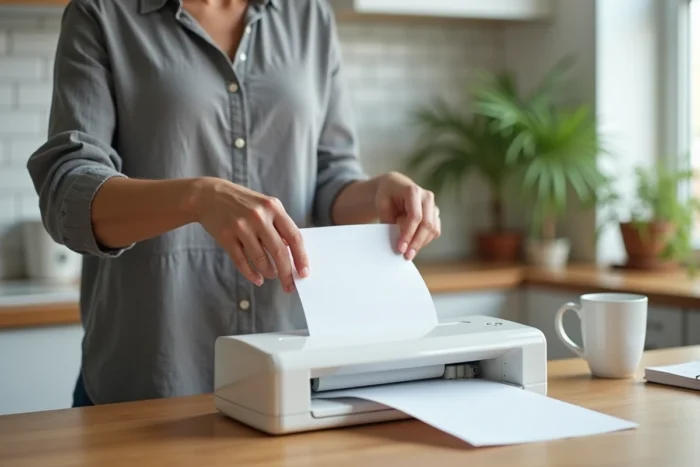
Domestic laminating suffers from a technical blind spot that most guides ignore: the behavior of the film according to the weight of the substrate. A standard paper and a rigid card do not react the same way to heat, and this is where failures (bubbles, warping, peeling) originate.
Substrate weight and pouch thickness: the technical duo to master
We regularly observe the same reflex among users: buying laminating pouches without considering their thickness in microns or the weight of the document to be protected. The result is a soft lamination on a thin substrate, or a difficult passage through the machine on thick cardboard.
The basic rule is simple. The lighter the document (standard paper), the more a moderately thick pouch is sufficient. For a rigid card or cardboard substrate, you need to increase the microns so that the film adheres properly without the whole thing getting stuck in the rollers.
- Thin pouches: suitable for standard weight sheets, they offer flexibility that is suitable for frequently handled documents (receipts, memos, revision sheets).
- Medium thickness pouches: the most versatile compromise for laminating a small format card or an administrative document that you slip into a binder.
- Thick pouches: reserved for substrates intended for intensive use (signage, routine boards, badges). They significantly stiffen the final result.
Before inserting anything into a laminator, check that the machine accepts the combined thickness (pouch + document). An entry-level device designed for thin pouches may not heat a thick pouch sufficiently, resulting in partial sealing.
For those who wish to delve deeper into the matter, knowing how to laminate a document or card also involves choosing the right temperature setting based on these parameters.

Cold lamination vs. iron: real limits of each method
Cold lamination (self-adhesive pouches) and the iron method with parchment paper come up in all consumer articles. We recommend understanding precisely what each technique can and cannot do before diving in.
Self-adhesive pouches: practicality versus durability
Transparent adhesive sheets are applied without heat. You peel off the protective film, apply the document, and burnish. The adhesion is immediate but sensitive to humidity over the long term. For a substrate handled daily (canteen card, weekly planner), the film eventually starts to peel at the corners after a few months.
This method remains relevant for occasional or temporary use. It is also suitable for inkjet printed documents whose pigments do not withstand the heat of a traditional laminator well.
Iron and parchment paper: the temperature trap
Applying an iron to a laminating pouch via a sheet of parchment paper works, provided two constraints are respected. The temperature must remain low (synthetic setting), and the movement must be slow, steady, without excessive pressure.
An iron that is too hot melts the film unevenly, creating dull areas or blisters. A too-quick pass leaves unsealed strips. We find that the failure rate on the first attempt with this method is significantly higher than with a laminator, even an entry-level one.
Targeted lamination: do not laminate the entire document
A recent trend, particularly among parents of children with ADHD and teachers, is to laminate only the functional pages of a document rather than the entire document. The logic is twofold: reduce plastic consumption and concentrate protection where it is useful.
An activity booklet intended for travel does not need to be fully laminated. Only the cover and the reusable game pages (routine board, emotion cards, tracking sheets) benefit from being protected. The standard text pages, handled less often, remain in free paper.
This reasoning also applies to domestic documents. Laminating a recipe consulted every week makes sense. Laminating an entire binder of recipes that you rarely flip through amounts to wasting pouches without any real gain in durability.
Recycling and lamination: an incompatibility to know
A laminated document can no longer be recycled in the standard paper stream. The polymer film that coats the sheet contaminates the recycling batch. Sorting centers explicitly request not to place laminated paper in the paper/cardboard bin.
This constraint increasingly weighs in the decision to laminate or not. For a short-lived document (event poster, monthly schedule), a removable transparent pouch or a rigid document holder offers equivalent protection without rendering the paper unrecoverable.
If lamination remains the best option for substrates intended for intensive and prolonged use, it should be a deliberate choice rather than a systematic reflex. Assessing the useful lifespan of the document before running it through the machine avoids both pouch waste and the production of non-recyclable waste.
The right decision ultimately rests on three criteria: the frequency of document handling, its expected lifespan, and the type of printing used. An inkjet substrate handled every day justifies a thick pouch run through a laminator. A laser-printed sheet consulted once a month suffices with a transparent binder pouch, reusable and recyclable separately.