Aplouf is a French-speaking platform dedicated to cats that combines fun content, practical advice, and exchanges among enthusiasts. The site is aimed at cat owners looking for inspiration to engage their pets and a community space focused on life with an indoor cat.
Mental stimulation for cats: what the term “feline enrichment” really changes
Recent content on cat toys no longer just talks about feather toys or bouncing balls. The vocabulary has shifted towards the notion of feline enrichment, a term that encompasses mental stimulation, autonomous engagement, and adapting play to the cat’s natural behavior.
This lexical shift is not trivial. It reflects a change in approach among owners: play is no longer seen as mere entertainment, but as a lever for overall well-being. Platforms like Aplouf integrate this logic by offering content that goes beyond simple product recommendations.
For cats living exclusively indoors (a growing proportion in French households), the stakes are particularly high. A feline that does not hunt, climb, or patrol outdoor territory needs structured substitutes. This is where specialized communities position themselves, sharing experiences on what truly works in daily life.
To better understand this approach, you can discover the Aplouf.com site and its sections dedicated to games and feline life.
Interactive cat toys: sensors, adaptive movement, and limitations
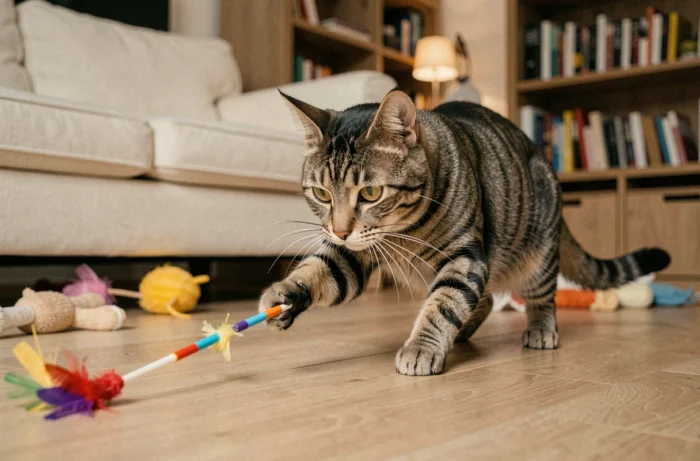
So-called “smart” toys represent a strong trend in 2026. Equipped with motion sensors and USB rechargeable, these items promise to maintain a cat’s attention even in the absence of its owner. The principle: movement that adapts to the cat’s reactions, mimicking the erratic behavior of prey.
On paper, the concept addresses a real problem. An indoor cat left alone for several hours a day can develop boredom-related behaviors (excessive scratching, compulsive licking, weight gain). An autonomous toy capable of triggering hunting sequences seems a logical solution.
What field feedback nuances
Feedback from owners in feline communities diverges on this point. Some cats quickly lose interest in repetitive movements, even adaptive ones. Others find real engagement for several weeks before boredom sets in.
- The rotation of toys remains the most shared advice: alternating three or four items on a weekly cycle rekindles the cat’s interest without additional purchases
- Adaptive movement toys work better in conjunction with interactive playtime with the owner, not as a total replacement
- The noise level of some motorized models can deter fearful cats, a factor rarely mentioned in product descriptions
An interactive toy does not replace human interaction, but it can fill the gaps during absences if the cat is receptive to it. Communities like Aplouf allow for gathering this feedback before making a purchase.
Materials for cat toys: the rise of sustainability criteria
Another area of discussion gaining traction concerns the materials used in toy manufacturing. The demand for toys made from natural and non-toxic materials is increasing, driven by a growing sensitivity to environmental and health issues.
The most attentive owners now check the composition of dyes, the source of feathers, and the nature of adhesives used. A cat that chews on a toy for several minutes a day potentially ingests micro-particles, raising questions about the safety of materials beyond just the playful aspect.
Eco-friendly toys: a market still hard to read
The available data does not allow for a conclusion on the exact market share represented by eco-friendly cat toys. Labels remain rare in this segment, and claims of “natural” or “eco-friendly” are not subject to harmonized certification in Europe for pet accessories.
The trend towards recycled materials and products with natural content (wood, hemp, wool felt) is well documented in recent market analyses. For an owner concerned about this criterion, checking the list of components is more reliable than relying on a self-proclaimed label.
Online feline community: what distinguishes a useful space from a simple forum
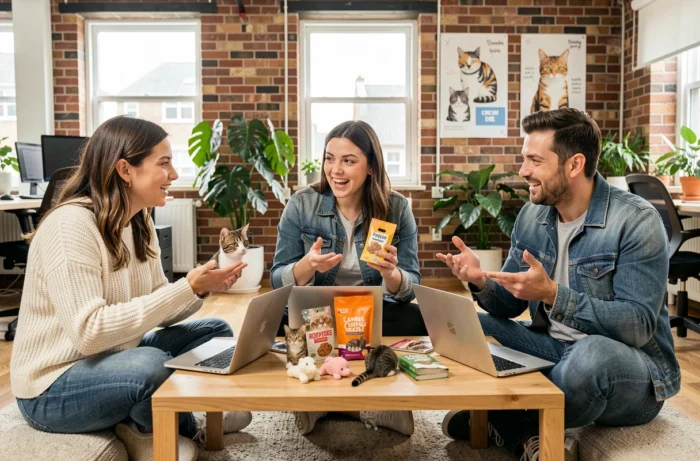
The number of websites, groups, and forums dedicated to cats is abundant. What differentiates a community like Aplouf is the nature of the exchanges offered: anecdotes, photos, but also care advice and shared experiences on concrete situations (adapting a kitten, cohabitation between cats, managing an anxious cat).
A useful community space can be recognized by a few markers:
- Responses are based on lived experiences rather than copy-pasting from generic sheets
- Content is moderated to avoid risky medical recommendations
- The diversity of cat profiles represented (breeds, ages, lifestyles) allows for cross-experiences
The market is structuring around indoor cats, and online communities play an increasing role in supporting these owners. An apartment cat poses specific questions that generic guides do not always cover: vertical space management, handling solitude, choosing toys suitable for a limited space.
Aplouf fits into this logic by combining an accessible tone with content that goes beyond a simple catalog of breeds or products. For owners who want to go beyond standardized recommendations, this type of platform offers a community filter that online pet store product sheets do not provide.