
Installing an aquarium of several hundred liters in a property changes the risk profile of the real estate. Property management for aquarium enthusiasts goes beyond choosing a room or interior design: it involves questions of insurance, co-ownership, and rental liability that few owners anticipate.
Aquarium and floor load: what the co-ownership regulations do not always say
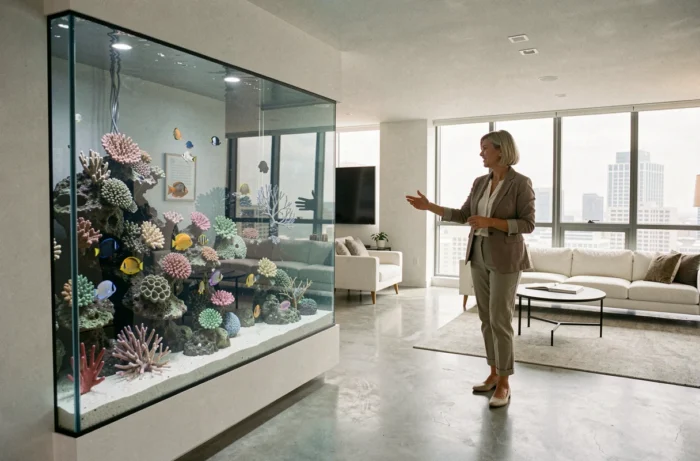
A large-capacity reef aquarium, once filled, equipped, and placed on its stand, represents a concentrated mass on a small surface area. The floors of older buildings were not designed to support this type of point load. Before any installation, it is essential to check the floor’s resistance at the installation point, which may require the opinion of a structural engineering firm.
Most co-ownership regulations do not explicitly prohibit aquariums. However, they do require that the building’s integrity is not compromised and that no nuisances are caused to other co-owners. Damage caused by a poorly installed aquarium can engage the liability of the occupying owner or the landlord who authorized the installation.
For owners managing multiple properties who wish to cross-reference real estate data and constraints related to aquaristics, the real estate page of My Fish Book lists useful resources for this intersection of passion and property.
Home insurance and water damage related to an aquarium
Aquariums are recognized as a potential source of claims in home insurance contracts in France. The water damage guarantee, which is mandatory in all home insurance contracts on the French market, covers damages caused by a tank rupture or accidental overflow, both to the insured’s residence and to the neighbors’ property.
The friction point lies in the deadlines and the procedure. The Insurance Code imposes a reporting deadline of 5 working days for any water damage. This deadline applies to claims caused by an aquarium just as it does to a classic plumbing leak.
| Situation | Home insurance coverage | Who reports |
|---|---|---|
| Owner-occupant, aquarium in their residence | Water damage guarantee of the home insurance contract | The owner |
| Tenant, aquarium authorized by the lease | Tenant insurance (liability + water damage) | The tenant |
| Damage to a neighbor in co-ownership | IRSI agreement (building damage) | Each party with their insurer |
In co-ownership, the IRSI agreement structures the management of claims between insurers when water damage affects multiple units. The insurer of the damaged unit takes care of leak detection and initial repairs, regardless of who is responsible, which speeds up the processing of the case.
Deductibles and exclusions to check
All contracts provide for a deductible for water damage. Its amount varies by insurer. An aquarist with a large installation should compare deductibles and check that the contract does not contain an exclusion clause related to the volume of water stored in the residence.
Some companies require a specific declaration when the total water volume exceeds a certain threshold. Failing to report it can lead to a reduction in compensation in the event of a claim.
Rental management and aquaristics: obligations of the landlord and tenant
A landlord renting a property to an aquarium enthusiast faces a concrete decision: allow the installation of an aquarium or prohibit it in the lease. The law does not prohibit the possession of an aquarium in a rented property, but the lease can frame the conditions of installation (location, maximum volume, obligation for additional insurance).
- The tenant must have home insurance covering water damage, which includes claims related to the aquarium
- The landlord can require a specific clause in the lease mentioning the aquarium and its constraints (weight, location, maintenance)
- In case of damage to the floor or walls due to prolonged humidity, the tenant’s liability may be engaged for rental repairs
- The landlord remains responsible for the floor’s integrity and the compliance of electrical installations near the water

A precise entry inventory, mentioning the planned location for the aquarium and the condition of the flooring, protects both parties. Photographing the area before and after installation is a simple but effective precaution in case of disputes.
Real estate development suitable for aquaristics: work items to anticipate
Integrating an aquarium into a real estate project (purchase, renovation) involves targeted work. Reinforcing the floor, providing water supply nearby, drainage, and a dedicated electrical circuit are the four main items.
Electricity and water: two networks to secure
An aquarium requires several electrical outlets (pump, lighting, heating, filter) located very close to the tank. Electrical standards impose minimum distances between water points and outlets. A dedicated electrical circuit with a differential circuit breaker protects the installation and reduces the risk of short circuits in case of water splashes.
The water supply and drainage facilitate regular water changes, which represent the most frequent maintenance task. Planning these connections during the construction phase avoids temporary setups that often lead to leaks.
Floor reinforcement
For an aquarium exceeding a few hundred liters, reinforcing the floor with a beam or a support beam may be necessary, especially on upper floors. This work item, rarely budgeted in advance, is nonetheless the primary condition for the structural safety of the property.
Property management for an aquarist relies on measurable technical choices: floor resistance, electrical compliance, appropriate insurance coverage. These parameters determine both the longevity of the aquatic installation and the value of the real estate itself.