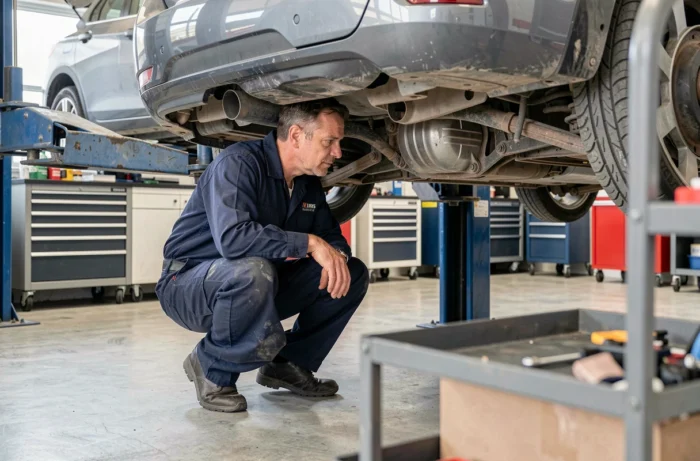
The EAT8 automatic transmission, developed by Aisin and installed on a wide range of Peugeots, is the subject of ongoing debate. Peugeot presents the fluid in this transmission as a “lifetime” fill, requiring no intervention. Aisin, on the other hand, recommends a fluid change between 60,000 and 80,000 km depending on usage. This contradiction deserves detailed examination, as it directly affects the longevity and cost of ownership of the vehicle.
Manufacturer vs. Supplier: Who to Trust for EAT8 Fluid Change
The term “lifetime” used by Peugeot (and more broadly by the Stellantis group) actually refers to the theoretical lifespan of the vehicle as projected by the manufacturer. This duration does not always coincide with the actual usage by owners, particularly those who keep their cars for over ten years or exceed standard mileage.
Aisin, which designs and manufactures the EAT8, explicitly anticipates fluid service for this transmission. The gap between the two positions is significant: it determines whether the owner incurs a preventive maintenance expense. On specialized forums, feedback varies on this point, with some owners driving well beyond 100,000 km without a fluid change and without symptoms, while others experience jolts as early as 70,000 km in urban use.
Planning the maintenance of the Peugeot EAT8 automatic transmission according to Aisin’s recommendations rather than the manufacturer’s remains the most prudent approach for those wishing to extend the transmission’s lifespan.
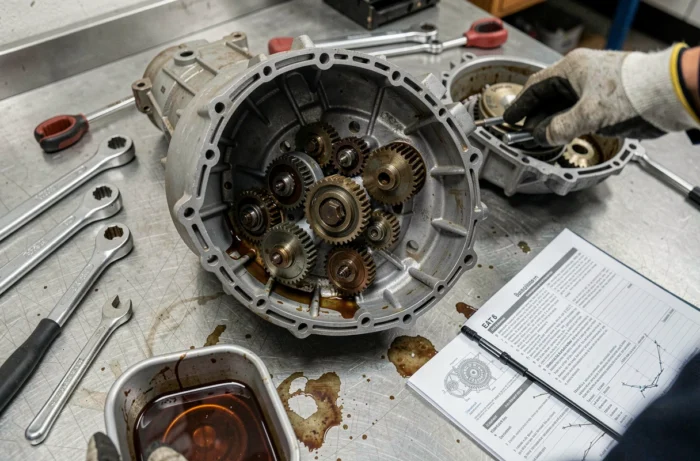
Urban Use vs. Highway Use: The Real Impact on EAT8 Transmission Fluid
Existing content on the subject rarely mentions the concrete difference between driving types. Feedback compiled between 2024 and 2026 shows that intensive urban use (short trips, traffic jams, repeated stop-and-go) significantly accelerates fluid degradation.
In the city, the transmission puts more strain on the torque converter and frequently shifts gears at low speeds. The oil heats up more often without benefiting from the cooling provided by a constant airflow on the highway. It becomes contaminated more quickly with metal particles and moisture.
Conversely, a vehicle primarily driven on highways maintains the transmission at a stable regime, with less hydraulic strain. The fluid change interval can vary from one to two times depending on the usage profile. An urban driver should aim for the lower end of Aisin’s range, while a highway driver can reasonably expect more.
Particular Cases to Monitor
- Vehicles used for regular towing put similar strain on the transmission as intensive urban use, even on open roads.
- Hybrid models equipped with the EAT8 add an additional constraint: transitions between the thermal and electric engines alter the load cycles on the transmission.
- A vehicle often driven at full load (family, utility) subjects the fluid to higher pressures than average, accelerating its aging.
Actual Cost of an EAT8 Fluid Change: Static vs. Dynamic Change
Two methods coexist for renewing the fluid in the EAT8 transmission, and their costs differ significantly. The static change involves gravity draining the lower pan. It only replaces a portion of the total fluid contained in the system, as some remains trapped in the torque converter and lines.
The dynamic change replaces almost all of the fluid using a machine that injects new oil while the engine runs, pushing out the old fluid through circulation. This method is more comprehensive, but it requires specific equipment that not all garages possess.
Comparison of the Two Methods
| Criterion | Static Change | Dynamic Change |
|---|---|---|
| Proportion of Fluid Renewed | About half | Almost all |
| Required Equipment | Common tools | Dedicated machine |
| Duration of Intervention | Less than an hour | One to two hours |
| Indicative Price | More accessible | Significantly higher |
The choice between the two depends on the mileage and history of the vehicle. For a transmission that has never been changed beyond 100,000 km, the dynamic change presents a better benefit/risk ratio. For a regularly maintained vehicle, the static change may suffice if repeated at reasonable intervals.
Electronic Reset and Fluid Choice: Two Overlooked Points
After any fluid change in the EAT8 transmission, resetting the adaptive parameters via a diagnostic tool is recommended. The transmission gradually learns the driver’s behavior and adjusts its shift points. If the fluid changes but the parameters remain calibrated to degraded fluid, the first kilometers after the change may exhibit unusual shift changes.
Regarding fluid, the EAT8 requires a specific ATF oil. Using an incompatible product can damage seals and solenoids. Aisin references its own fluids for this transmission, and several suppliers offer certified equivalents. Checking the exact compatibility with the manufacturer’s reference before any intervention remains a non-negotiable precaution.
- Demand a fluid that complies with Aisin specifications (the exact reference is found in the maintenance booklet or on the transmission case).
- Request the reset of the adaptive parameters at the workshop, even if some mechanics consider this step optional.
- Keep the detailed invoice: in case of resale, a documented maintenance history reassures the buyer and can influence the price.

Maintaining the EAT8 transmission remains a topic where caution costs less than repair. A replaced eight-speed automatic transmission represents a budget of several thousand euros, while a preventive fluid change costs hundreds. The cost differential between prevention and repair alone justifies not blindly following the “lifetime fluid” mention.