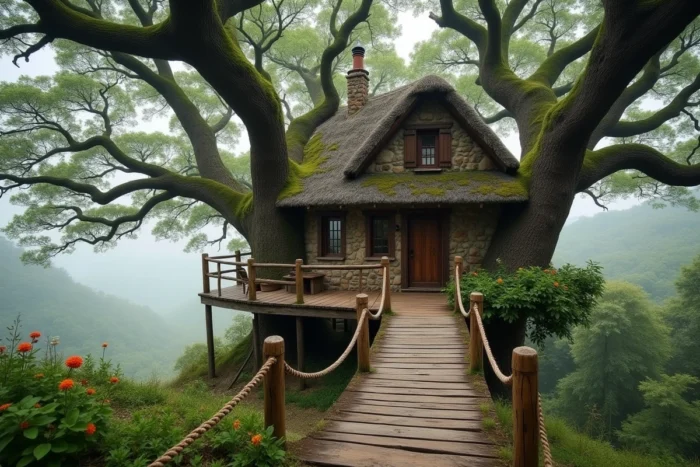
Treehouse, transparent bubble facing the stars, Mongolian yurt set in Auvergne: the market for unusual accommodations in France is no longer what it was five years ago. With 2,226 professional sites recorded in 2024, according to the 4th National Observatory of Unusual Accommodation led by the Cabinet Alliances and Esprit Insolite, the sector has surged by 30% compared to 2022.
Behind this growth, the differences in price, comfort, and labeling among options deserve a close examination.
Unusual accommodation in France: prices and volumes compared to traditional options
The first reflex before booking an unusual night should be to measure what you are actually paying compared to a guesthouse or charming hotel. Market data shows a clear gap.
| Criterion | Traditional accommodation (gîte, guest room) | Unusual accommodation (cabin, dome, bubble, tiny house) |
|---|---|---|
| Average price per night | Base reference | 2 to 3 times higher than traditional accommodation |
| Growth in the number of sites (2021-2026) | Stable | About 65% growth since 2021 |
| Number of professional sites (France, 2024) | Not consolidated in a single observatory | 2,226 sites recorded |
| Most densely populated regions | Homogeneous distribution | Concentration in Auvergne-Rhône-Alpes, Occitanie, Nouvelle-Aquitaine |
These figures, from the analysis published by Pôle Implantation Tourisme in 2026, reveal a market that is rapidly structuring. The multiplication of geodesic domes and tiny houses has increased the supply, but also the prices. For a couple looking for a night in nature, the bill can easily double compared to a guest room of equivalent quality.
Comparing available options before booking remains the most effective approach, especially through the accommodation offered by 1, 2, 3 … voyagez! which allows filtering stays by type of accommodation and region.
Cabin, bubble, or yurt: what the type of accommodation changes concretely
Not all unusual nights are created equal. The choice of format determines the level of comfort, exposure to the elements, and capacity for a family.
Treehouse and comfort at altitude
The treehouse remains the most requested format. It generally offers a double bed, sometimes a small stove, and a suspended terrace. Access via ladder or walkway limits practicality for young children or people with reduced mobility. Most domains impose a minimum age, often around six years.
Transparent bubble and weather constraints
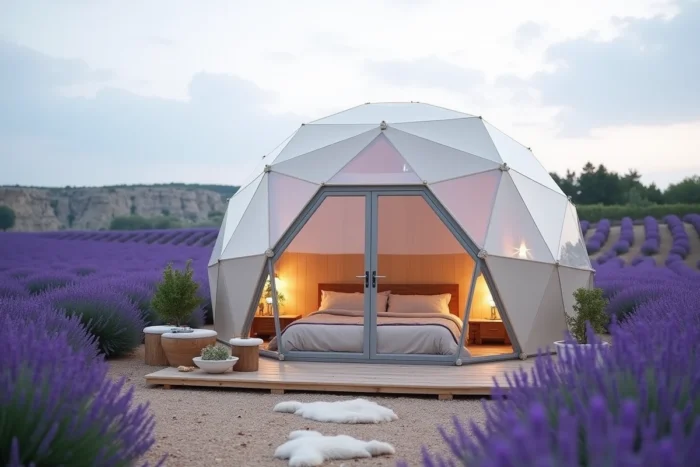
Sleeping under a transparent bubble promises a striking experience on a clear night. However, summer heat can make the bubble uncomfortable from the morning, even with ventilation. The lack of private sanitary facilities in some structures requires checking the amenities before booking. This format is better suited for the shoulder seasons than for the peak summer vacation period.
Yurt, dome, and tiny house: family-friendly alternatives
The yurt and geodesic dome offer more floor space, making them suitable for family stays. Some tiny houses come with a fully equipped kitchen, turning the unusual night into a true self-catering experience. The price reflects this upgrade: a tiny house with a private spa falls into the high end of the market.
- Treehouse: high demand, limited access for young children, mid-range price per night
- Transparent bubble: striking visual experience, sensitive to weather conditions, variable comfort
- Yurt or dome: family space, decent insulation, available in spa version
- Tiny house: complete autonomy (kitchen, bathroom), highest price in the unusual segment
Ranking of holiday villages: regulations changing from July 2026
A parameter often overlooked by travelers concerns regulations. Since July 1, 2026, new texts govern the classification of holiday villages in France, according to information published by Atout France and relayed by regional CCIs. This classification now includes more stringent environmental criteria.
For unusual accommodations located within holiday villages or structured domains, this evolution has direct consequences. Operators must comply with a framework that evaluates waste management, energy consumption, and the landscape integration of structures.
A traveler who books a stay in a certified domain after this date thus benefits from a higher level of guarantees than what existed before. Checking if the chosen site displays its updated classification helps avoid unpleasant surprises.
Nature holidays in France: three regions where unusual offerings are concentrated
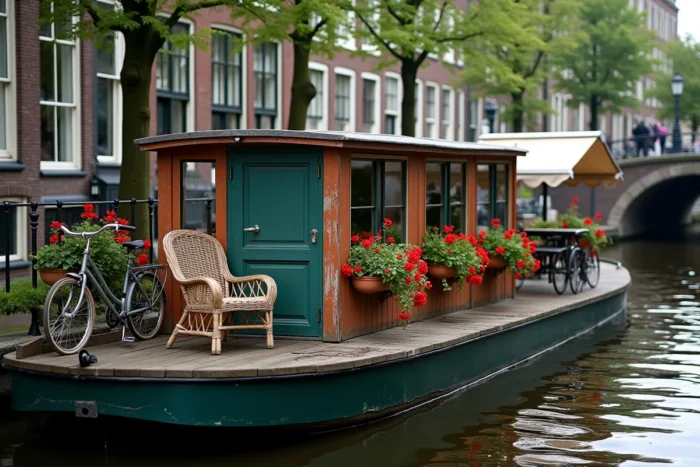
The geographical distribution of the offer is not uniform. Three areas capture the majority of professional unusual accommodations.
Auvergne-Rhône-Alpes leads the ranking thanks to the diversity of its landscapes (volcanoes, lakes, medium mountain forests) and the density of already established domains. Occitanie follows, driven by the Mediterranean hinterland and the Cévennes. Nouvelle-Aquitaine completes the trio with an offer that mixes the Atlantic coast and the Périgord countryside.
Outside of these three regions, the offer remains more dispersed. Hauts-de-France has recently been developing unusual summer getaways, but the volume of sites remains significantly lower. For a trip off the beaten path, targeting a region with a high density of accommodations allows for more choices in terms of dates and formats.
The unusual segment still represents a modest fraction of the French tourist accommodation stock, but its 65% growth since 2021 reflects a lasting change in travelers’ expectations. Before booking, comparing the relationship between the displayed price and the actual level of comfort (sanitary facilities, insulation, kitchen equipment) remains the best filter to distinguish a memorable experience from a disappointing night at an inflated price.