
The fashion accessories market is undergoing a phase of technical restructuring. Between the tightening of European regulations on environmental claims and the evolution of materials, the criteria for selecting an accessory are no longer limited to visual appeal. We break down the points that truly matter to enhance your style every day without falling into current traps.
Directive 2024/825 and fashion accessories: what changes from September 2026
The European directive 2024/825, known as Empowering Consumers for the Green Transition, comes into effect on September 27, 2026. It directly targets accessories sold in the EU: bags, jewelry, belts, scarves.
Generic claims like “eco-friendly” or “sustainable” become illegal if the brand cannot demonstrate recognized environmental performance through an official scheme such as the EU Ecolabel or Type I eco-label. A leaf logo or a homemade seal is no longer sufficient.
In practical terms, sustainability labels that are not certified by an independent body are considered unfair commercial practices. We recommend systematically checking for the presence of third-party certification on any accessory that claims a responsible positioning. Self-created pictograms, which are very common on online product sheets, must be removed or linked to a recognized certification.
This tightening has a direct effect on consumer choice: it encourages a preference for brands that are transparent about their materials and production chain, rather than those that capitalize on vague messaging. To explore accessories on Owly Mary, this traceability requirement is already a relevant selection criterion.

Materials and finishes: the technical criteria for a lasting accessory
An on-trend accessory that doesn’t last two seasons has no stylistic or economic value. The quality of materials remains the first filter to apply before any purchase.
Steel, brass, plated: understanding alloys in jewelry
316L stainless steel dominates accessible jewelry for a simple reason: resistance to oxidation, durability, compatibility with sensitive skin. Brass, often used in entry-level products, tarnishes quickly without appropriate surface treatment. Gold plating, on the other hand, is measured in microns of deposition: below a certain threshold, wear appears within a few months.
We observe that the trend for steel necklaces and rings, very present this season, responds as much to a logic of durability as to an aesthetic choice. The matte or brushed finish of steel easily integrates into an everyday style without overwhelming the outfit.
Bags and belts: spotting quality by touch
On a bag or belt, three technical points deserve attention:
- The consistency of the seams and the strength of stress points (handles, buckle, closure) – a loose thread or a skipped stitch indicates sloppy assembly.
- The flexibility of the main material: leather or faux leather that is too rigid will crack, while too soft will deform under the weight of its contents.
- The metal parts (clasps, rings, rivets): their relative weight often indicates the quality of the alloy used. A clasp as light as plastic will not hold up.
The oversized format, very trendy for bags, imposes additional constraints on the internal structure. An oversized bag without a frame or reinforcement loses its shape within a few weeks.
Trendy accessories with high visual impact: focus on three key pieces
Rather than accumulating, we recommend concentrating investment on three categories of accessories that truly transform a look.
The repositioned fanny pack
The fanny pack has left the sports realm to settle into everyday wardrobes. Worn crossbody rather than at the waist, it provides a diagonal line that structures a loose or monochrome outfit. Versions in grained leather or technical nylon offer the best compromise between lightness and durability.
Sunglasses as a signature
Sunglasses remain the accessory that most alters the perception of a face. Oversized frames are making a strong comeback, but the choice should remain proportional to the face shape. A frame that is too wide on a narrow face creates an imbalance that style cannot rectify. Opt for lenses with certified UV protection rather than purely decorative models.
Structuring belts and discreet jewelry
The belt serves both a technical and aesthetic role: it redefines the waistline and can transform the silhouette of a dress or coat. Wide models work well with fluid pieces, while thin models suit more fitted looks.
On the jewelry side, the layering trend (stacking necklaces or bracelets) requires material coherence. Mixing brushed steel and gold-plated brass in the same stack creates a visual dissonance that even an untrained eye can perceive.
Building a coherent style with accessories: the ratio rule
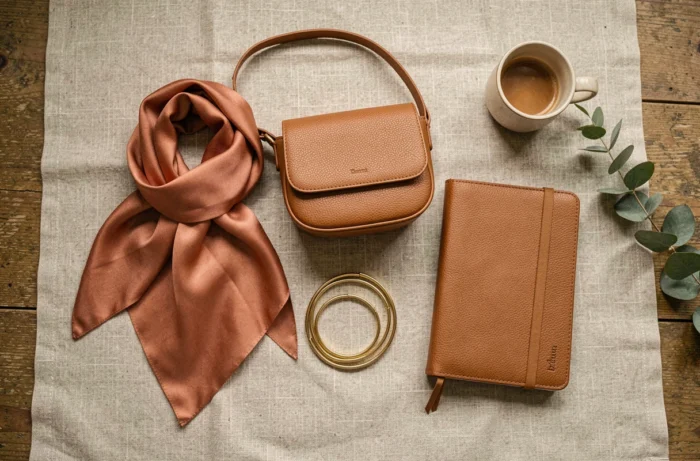
A simple principle guides successful accessorizing: each addition must either reinforce the main line of the outfit or create a unique focal point. Two competing focal points (a flashy patterned bag and oversized colorful sunglasses, for example) neutralize each other.
We apply an empirical ratio: one dominant accessory, two supporting accessories, zero superfluous accessories. The dominant accessory draws the eye (the bag, the sunglasses, a statement necklace). Supporting accessories complement without competing (a simple belt, a thin ring).
This approach works regardless of the context, from casual to semi-formal. It also avoids the pitfall of excess, where each piece shouts louder than the last and where style disappears under accumulation.
The choice of trendy accessories in 2026 relies on a dual filter: the verifiable quality of materials and the actual compliance of environmental claims. With the implementation of directive 2024/825, the benchmarks are changing. Better to have three well-chosen, traceable, and durable pieces than a collection of accessories whose composition and promises cannot withstand scrutiny.