
The French entrepreneurial landscape is undergoing a rapid restructuring phase. With the decline of traditional fundraising, the arrival of AI agents in business processes, and the rise of niche marketplaces, the business trends of 2025-2026 differ significantly from previous years. Several signals converge on the same observation: lightweight, self-funded, and specialized models are gaining ground against the logic of growth financed by venture capital.
Bootstrapping and Self-Funding: The Shift of Founders in 2026
Among the business trends reshaping the French ecosystem, the massive return of bootstrapping represents a structural evolution in financing logic.
More and more founders are choosing to finance their growth through profitability rather than through funding rounds. This movement particularly affects three categories of companies: ultra-niche micro-SaaS, productized services (packaged expertise in standard offers), and vertical B2B tools focused on compliance, cybersecurity, or back-office functions.
This shift reflects a growing distrust of traditional fundraising. Founders who adopt a disciplined self-funding approach prioritize lean structures, with small teams and controlled acquisition costs. The model is not new, but its scale in 2026 marks a change in entrepreneurial culture. Several analyses of entrepreneurship this year confirm that early profitability is becoming a credibility criterion, including among investors themselves.
Among the news from Business Futur, this trend towards bootstrapping is one of the topics that well illustrates the ongoing reconfiguration in the French startup ecosystem.
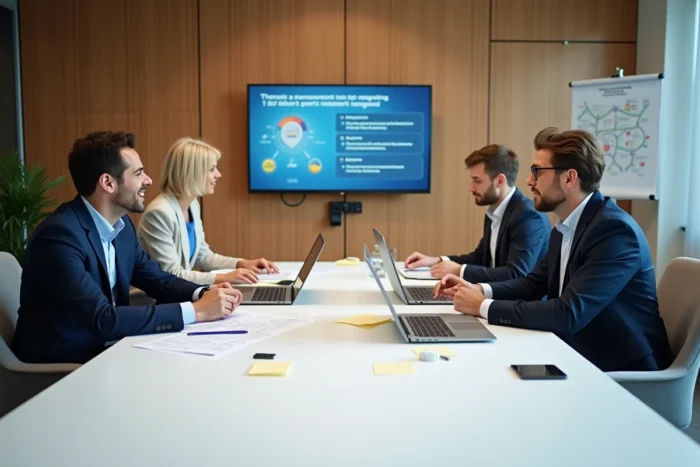
AI Agents in SMEs: From Experimentation to Operational Integration
Most articles on business innovation mention generative AI. They often remain at the level of general observation. The most significant evolution in 2026 concerns the operational integration of AI agents into the business processes of SMEs and mid-sized enterprises, well beyond mere experimentation.
An AI agent is not limited to generating text or images. It is a program capable of autonomously executing complex tasks: qualifying leads, handling support tickets, managing supplier follow-ups, and performing preliminary accounting analysis. The difference with a traditional chatbot lies in the agent’s ability to chain multiple actions without human intervention.
What This Means for Businesses
Some SMEs report substantial productivity gains on repetitive administrative tasks, while others struggle to integrate these agents into existing workflows. Technological maturity varies by sector.
The areas where adoption is progressing the fastest are customer management, automated marketing, and regulatory compliance. For companies that do not yet have a dedicated technical department, the main obstacle remains the initial setup and the reliability of results on specific business data.
- Automatic qualification and routing of incoming requests, with an error rate that decreases as the agent learns from the company’s context
- Generation of periodic reports (competitive monitoring, cash flow tracking) without manual intervention
- Pre-drafting of contractual or regulatory documents, which are then submitted for human validation
The available data does not yet allow for conclusions on the average return on investment of these deployments. Solution providers communicate optimistic figures, but independent feedback remains rare.
Niche Marketplaces and Productized Services: Two Rising Models
The model of the generalist marketplace has shown its limits. The trend in 2026 is moving towards ultra-specialized vertical marketplaces, focused on a specific sector or type of transaction. Rather than competing with large platforms, these marketplaces target segments where the supply remains fragmented and where trust between buyer and seller requires specific intermediation.
This dynamic is observed in diverse sectors such as professional equipment rental, connecting specialized service providers (certified craftsmen, regulatory consultants), or reselling stock between businesses. The common point: a market without a central aggregator where the value of the service relies on curation and verification.
Productized Service as an Alternative to Traditional Consulting
At the same time, productized services are gaining ground over custom consulting. The principle: transforming expertise usually sold by the hour into a standardized offer, at a fixed price, with a defined deliverable. A cybersecurity consulting firm offering a packaged audit in three days with a standard report fits this logic.
This model is appealing because it reduces the sales cycle, simplifies the purchasing decision for the client, and allows the provider to scale without multiplying hires. Field feedback shows that client companies, especially SMEs, often prefer a clear scope to an open mission proposal with an uncertain final budget.
- Packaged offers with predetermined deliverables and timelines, often sold online without a commercial appointment
- Transparent pricing that eliminates the negotiation phase and shortens the purchasing cycle
- Possibility to automate part of the production using AI tools, which enhances margins without degrading perceived quality

Ecological Transition and Business: Beyond Intentions
The ecological transition remains present in all trend lists. In 2026, the notable evolution concerns less the rhetoric than the regulatory constraints that force adaptation. The obligations for extra-financial reporting are gradually extending to mid-sized companies, creating a market for impact measurement tools and environmental compliance providers.
The circular economy, often cited as a trend, is becoming an operational subject for companies subject to traceability obligations in their supply chains. The textile, electronics, and agri-food sectors are at the forefront, with increasing demands on product lifespan and waste management.
The market that is structuring around these constraints, that of environmental compliance consulting, carbon tracking software, and recycling solutions, represents a concrete opportunity for entrepreneurs who master both the regulatory framework and technological tools. In contrast, “green” projects that rely solely on marketing positioning without regulatory grounding struggle to find their economic model.
The coming months will allow us to assess whether these dynamics—bootstrapping, AI agents, niche marketplaces, ecological compliance—reinforce each other or if some lose momentum in the face of market realities. One thing seems certain: the period favors structures capable of combining specialization, financial sobriety, and rapid technological adoption.