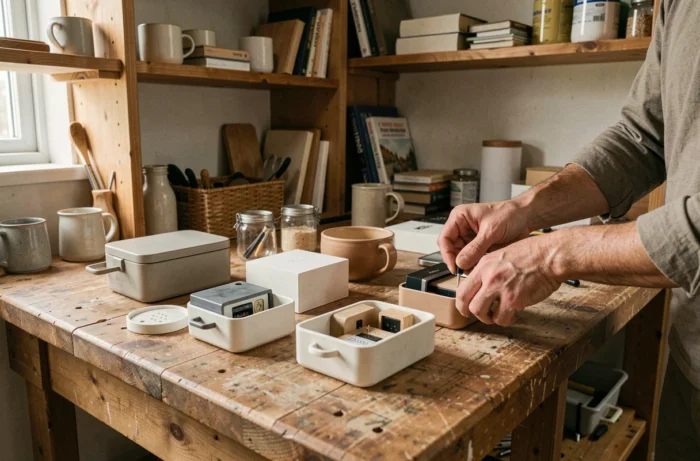
Burglar prioritize searching the mattress, nightstand, vases, and coffee boxes. Therefore, any secret hiding place at home must start from a technical observation: if the location appears on insurers’ theft prevention lists, it offers no protection. The ten solutions that follow exploit structural areas or objects whose apparent function distracts attention.
1. False drawer bottom with glued double floor
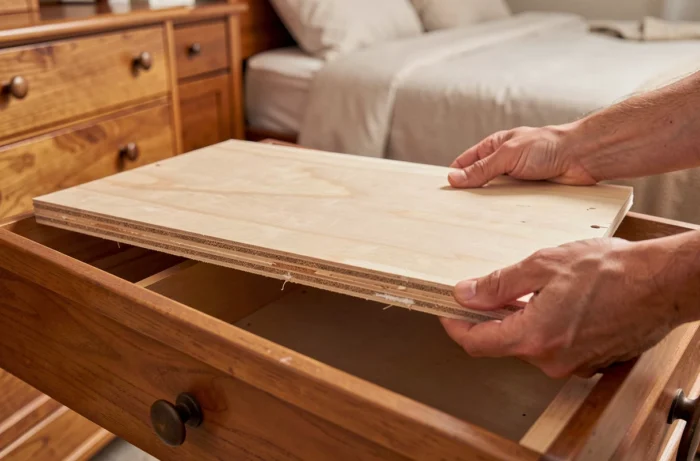
A kitchen or office drawer offers a dead space under the original bottom. We recommend cutting a 5 mm plywood sheet adjusted to the interior dimensions, placed on 15 mm battens. The residual space between the real bottom and the false bottom accommodates documents, cash, or USB keys.
The upper panel is held by friction or by two neodymium magnets embedded in the wood. A burglar opening the drawer sees cutlery or stationery, not the lower compartment. The weak point: a drawer that is too light compared to its visible contents may raise suspicion. Slightly weighting the false bottom with self-adhesive lead sheet solves the problem.
When looking to create a secret hiding place at home, the double drawer bottom remains one of the most reliable techniques because it does not alter the external appearance of the furniture.
2. Fake electrical outlet with junction box
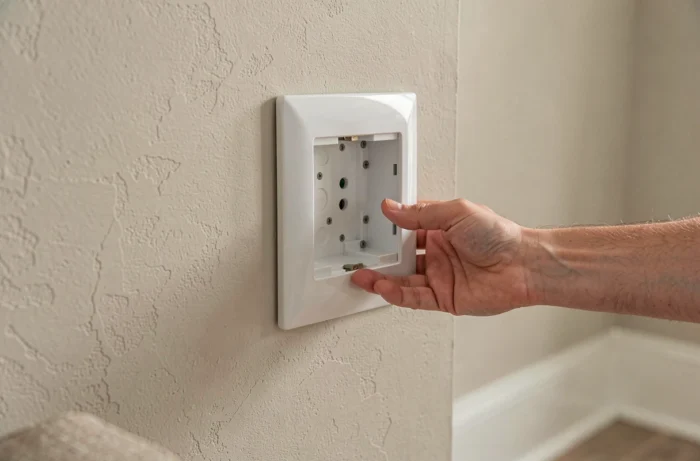
A standard wall outlet plate covers a 40 mm deep flush box. By installing a plate on an empty box (without wiring), you create an invisible wall safe of small volume. Jewelry, memory cards, and a small bundle of cash fit into this space.
The plate must be secured with quarter-turn screws or magnetic clips for quick access. Be careful never to use a box connected to the electrical network. We systematically place a discreet marker (slight pencil mark on the frame) to distinguish the fake outlet from the real ones.
3. Diversion safe disguised as a can or canister
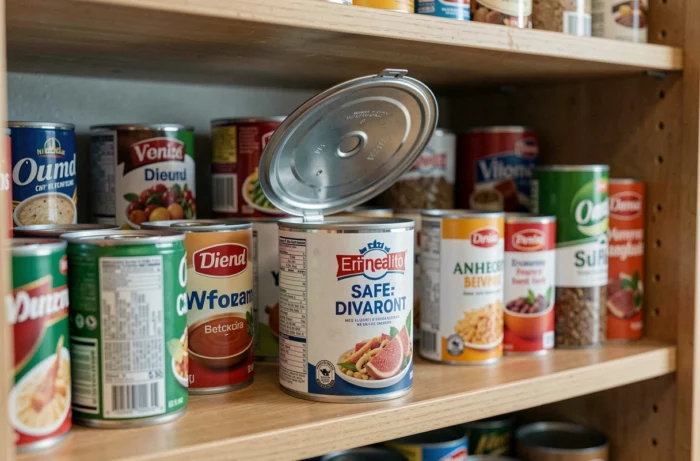
Diversion safes are everyday objects transformed into secure caches. A double-bottom soda can, a weighted tomato sauce jar, a hollow cleaning product bottle: these devices can be stored directly in the kitchen cupboard or refrigerator.
Recent security comparisons highlight their effectiveness precisely because a burglar does not empty the refrigerator. The selection criterion: the weight must match that of the real product. An empty can weighing 30 g instead of 350 g is immediately noticeable in hand.
4. Hidden hinge stair tread
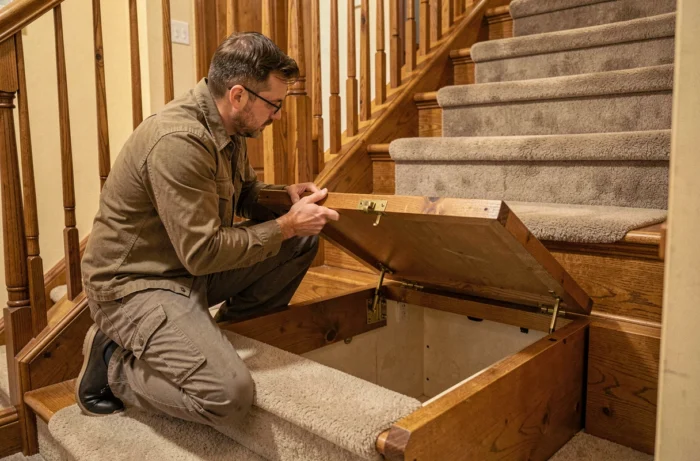
The riser of a wooden staircase is rarely disassembled during a search. By attaching the riser to an invisible piano hinge and a magnetic latch, you access a linear volume of about ten centimeters in height across the width of the tread.
This type of hiding place is suitable for flat objects: envelopes, passports, tablets. The finish must be impeccable: no visible gap between the riser and the stringer. A silicone seal tinted in the mass of the wood masks the cut line.
5. Fake ventilation duct in the basement
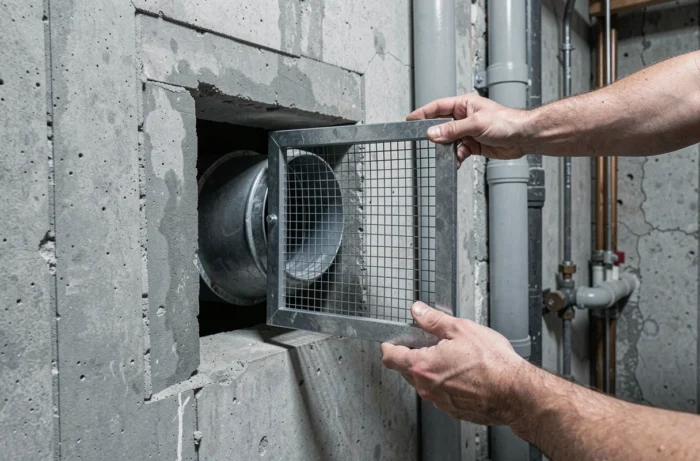
A section of rectangular galvanized duct fixed to the ceiling of a basement goes completely unnoticed among the existing technical networks. The section, closed by a removable screw cap, offers generous storage volume.
We recommend visually connecting it to real ducts with a bend to enhance the illusion. The limitation: the basement’s humidity requires placing items in a zip-lock bag before insertion.
6. Photo frame with reinforced back compartment
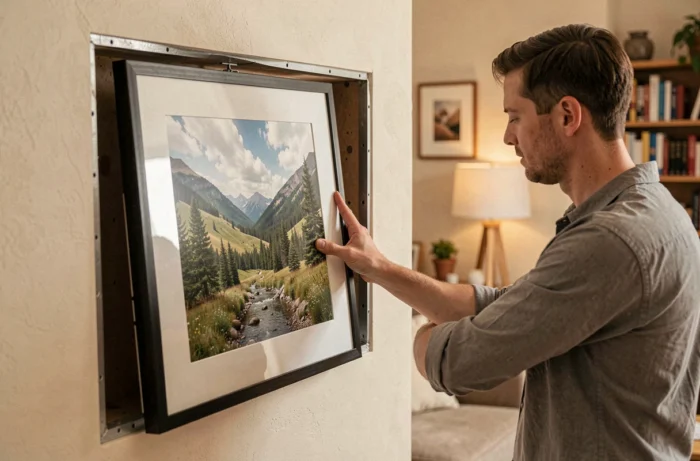
Insurers report that burglars look behind frames for taped envelopes. The countermeasure: a double-back frame with flush closure. The first back holds the photo, the second creates a compartment of 8 to 10 mm, closed by embedded clips.
Unlike a classic frame, nothing detaches when turning the frame over. You must activate the clips to access the contents. Prefer a heavy frame (solid wood) whose weight does not appear suspicious.
7. Fake PVC pipe under the sink
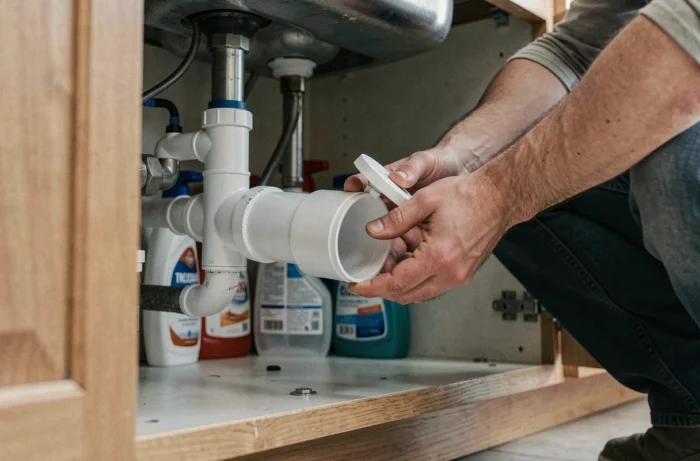
Under a kitchen or bathroom sink, an additional white PVC section blends in among the existing plumbing. The pipe is a tube with a diameter of 80 or 100 mm, capped at both ends with removable inspection plugs.
The technical key:
- Secure the tube with ties identical to those of the real pipes to standardize the visual appearance
- Orient the tube vertically to resemble a siphon or downspout
- Use gray PVC (drainage) instead of white (supply) if the existing pipes are gray
8. Hollowed-out book with cardboard reinforcement
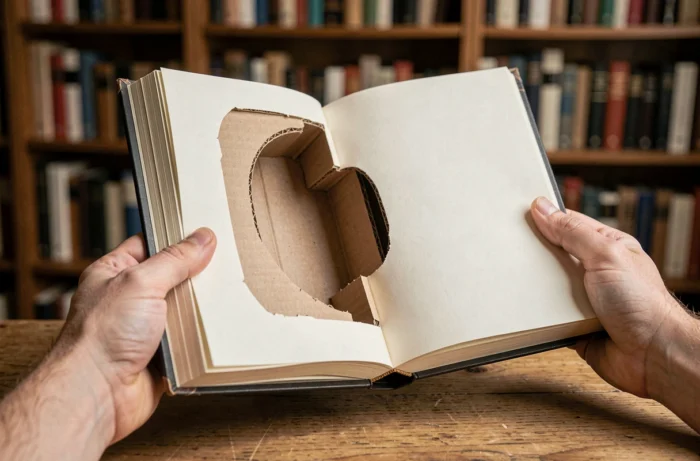
The hollowed-out book is a well-known hiding place, which seems to disqualify it. In practice, it still works as long as two rules are followed: the book must be placed in a dense bookshelf (not a shelf of five books) and its title must be boring (technical manual, directory, legal code).
The cut with a cutter is reinforced by a PVA glue on the peripheral pages. A rectangle cut 15 mm from the edges maintains the rigidity of the spine. Burglars sometimes flip through one or two books, but rarely an entire shelf of tax manuals.
9. Built-in safe behind a technical access hatch
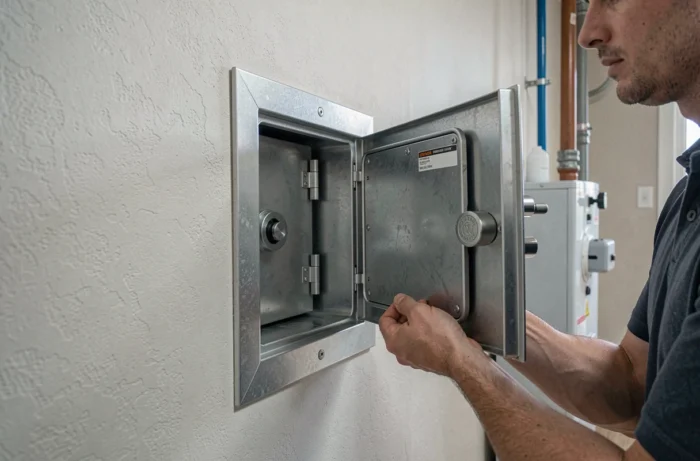
Drywall partitions offer exploitable thickness. A wall safe built into a access hatch (like a plumbing hatch) combines concealment and strength. The safe is fixed between the metal studs, and the hatch is covered with a tile or matching paint.
Models with biometric opening eliminate the risk of a lost key. Caution: the hatch should never be located near a real network (water, electricity) to avoid attracting a tradesperson during future work.
10. Weighted double bottom of a flower pot
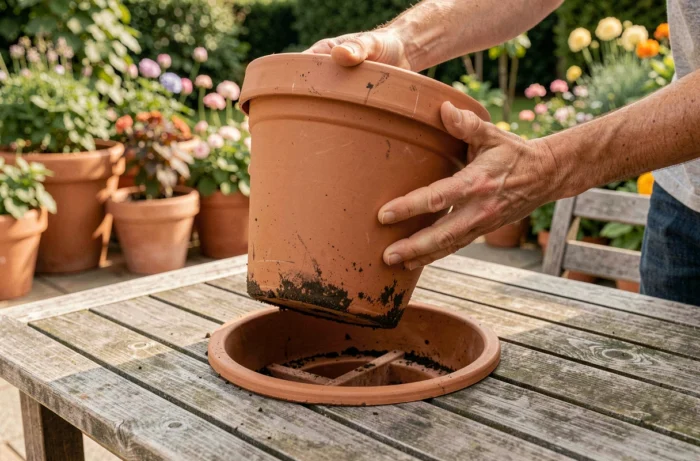
A large-diameter flower pot, placed on a terrace or in a living room, conceals a double bottom under the soil. The principle: a rigid disk (PVC, marine plywood) separates the soil from the lower compartment. The natural drainage of the pot justifies the presence of this disk in the eyes of anyone lifting the plant.
- Choose an opaque pot (terracotta, thick ceramic) to prevent any transparency
- Wrap items in a waterproof bag to protect them from residual moisture
- Maintain a living and healthy plant: an empty pot or a dead plant attracts attention
The best hiding place is one whose existence does not come to anyone’s mind. Each technique described here relies on a common principle: the object or area retains its apparent function. It is this visual and functional consistency that makes the difference, not the complexity of the mechanism.